

Most “best ultralight tents” lists rank by one number: trail weight. That is how you end up with a roundup that puts a 12 ounce trekking pole shelter above a tent that will actually keep a beginner dry, warm, and not miserable on their first three trips. Weight matters, but it is not the whole purchase. Price, setup difficulty, pole requirements, and how forgiving the fabric is when you make a mistake matter just as much, especially if this is your first ultralight shelter.
This guide ranks 12 of the most talked about ultralight tents on the market right now, from a proven two person classic that thru-hikers have trusted for years down to niche freestanding options that only make sense for a specific kind of camper. Every entry gets a category that reflects what it actually does best, not just where it lands on a spreadsheet. By the end, you should know exactly which one fits your trips, your budget, and your patience for pitching a non-freestanding shelter in the dark.
The Quick Ranking
- Zpacks Duplex Classic, Best Two-Person Ultralight Tent
- Durston X-Mid Pro 2+, Most Spacious Ultralight Tent
- Tarptent Double Rainbow, Best Budget Ultralight Tent
- Gossamer Gear The Two, Best Value Ultralight Tent
- Durston X-Mid Pro 1, Best Balance of Comfort and Weight for One
- Zpacks Pivot Solo, Best One-Person Ultralight Tent
- Nemo Hornet Elite OSMO 1P, Best Semi-Freestanding Ultralight Tent
- Hyperlite Mountain Gear Mid-1, Best Low-Weight Design
- Gossamer Gear The One, Best Lightweight One-Person Silnylon Tent
- Gossamer Gear The Free, Best Affordable Freestanding Tent
- Hyperlite Mountain Gear CrossPeak 1, Best Ultralight Freestanding One-Person Tent
- Hyperlite Mountain Gear CrossPeak 2, Best Ultralight Freestanding Two-Person Tent
Now let’s break down why each one earned its spot, who it is actually built for, and who should skip it.
1. Zpacks Duplex Classic: Best Two-Person Ultralight Tent

Price: around $749 | Weight: 17.9 oz (507 g) | Capacity: 2 person | Setup: 2 trekking poles, non-freestanding | Fabric: Dyneema Composite Fabric (DCF)
The Duplex Classic is the tent most other two person ultralight shelters get measured against, and it earns the top spot here because it is the rare option that is both extremely light and genuinely easy to live in. Two symmetrical doors and vestibules mean either sleeper can get in or out without climbing over their tentmate, and the 90 by 45 inch interior fits two standard width pads with room to spare. It has been a favorite among Appalachian Trail thru-hikers for years running, which says more about long term livability than any spec sheet does.
Best for: couples or duos who want the lightest fully enclosed two person shelter without sacrificing comfort, and hikers who already own or are willing to buy trekking poles.
Skip it if: you want a tent that pitches with its own poles, or you are not ready to pay DCF prices. If you are torn between this and the more spacious option below, this Duplex vs. X-Mid Pro 2 comparison breaks down the tradeoffs in more detail.
2. Durston X-Mid Pro 2+: Most Spacious Ultralight Tent
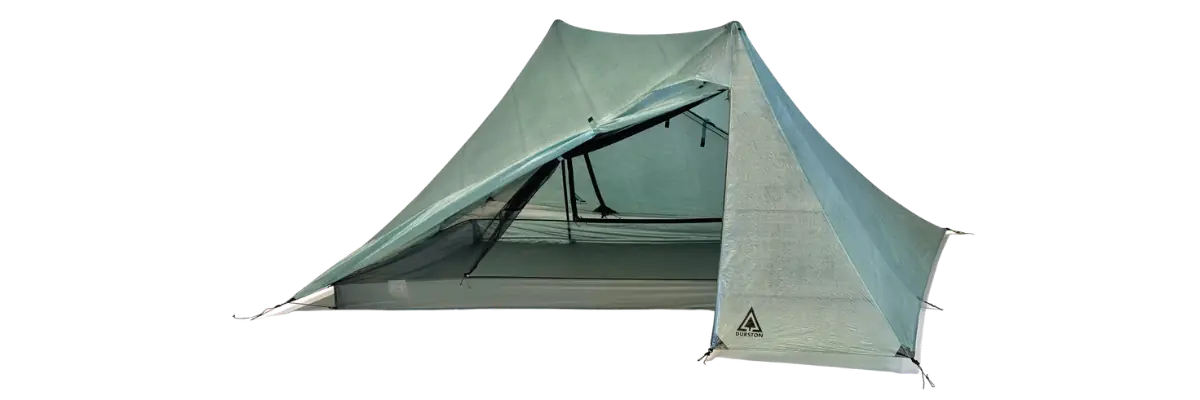
Price: starting around $669 (nylon floor) to $779 (DCF floor) | Weight: 19.2 to 21.5 oz (545 to 610 g) | Capacity: 2 person, wide pads | Setup: 2 trekking poles, non-freestanding | Fabric: DCF canopy, nylon or DCF floor
If the Duplex is the proven classic, the X-Mid Pro 2+ is the spacious upgrade. Durston widened the floor to 52 inches, which is the difference between fitting two standard pads and fitting two wide rectangular pads side by side, something almost nothing else at this weight class can claim. The offset pole geometry also keeps the poles out of the doorways entirely, so nobody is climbing over a trekking pole to get outside at 2am.
Best for: taller hikers, wide pad users, or anyone who has felt cramped in a standard 2P ultralight tent before.
Skip it if: you and your tentmate both use standard width pads, since the Duplex Classic gets you nearly the same experience for less money.
3. Tarptent Double Rainbow: Best Budget Ultralight Tent
Price: starting around $319 | Weight: about 2 lb 7 oz (1,107 g) with pole, stakes, and bags | Capacity: 2 person | Setup: single arch pole, can convert to fully freestanding with trekking poles | Fabric: silicone coated polyester fly, nylon floor
This is the tent most beginners should actually start with. The Double Rainbow costs less than half of most DCF options on this list and still comes in around 2.5 pounds, which is genuinely ultralight territory for a fully enclosed two person shelter. It uses its own arch pole so you are not required to own trekking poles, and it can be pitched semi-freestanding or fully freestanding if you do carry them. It is the least “specialized” tent here, which is exactly why it is the easiest one to recommend to someone who has never owned an ultralight shelter before.
Best for: newcomers to ultralight backpacking, budget conscious buyers, and anyone who wants a durable, forgiving tent before investing in Dyneema.
Skip it if: shaving every possible ounce matters more to you than price, or you camp regularly in conditions where you need maximum waterproofing.
4. Gossamer Gear The Two: Best Value Ultralight Tent
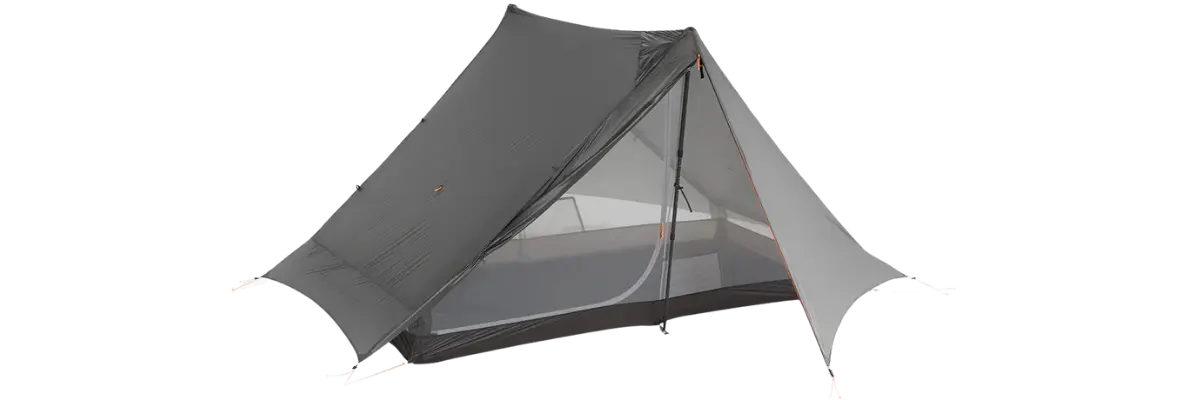
Price: around $375 | Weight: 23.5 oz (667 g) | Capacity: 2 person | Setup: 2 trekking poles, non-freestanding | Fabric: silnylon
The Gossamer Gear The Two undercuts most DCF two person tents by hundreds of dollars while only weighing a few ounces more, which makes it one of the best price to weight ratios on the market. It has large vestibules, two doors, and factory taped seams straight out of the box, so there is no extra seam sealing step before your first trip. The tradeoff is that it requires trekking poles and is a bit more finicky to pitch taut than a freestanding design.
Best for: hikers already using trekking poles who want DCF-adjacent weight without the DCF price tag.
Skip it if: you have never pitched a non-freestanding tent before and want the absolute easiest setup on your first few trips, in which case the Double Rainbow above is the gentler entry point.
5. Durston X-Mid Pro 1: Best Balance of Comfort and Weight for One

Price: starting around $599 | Weight: 15.5 to 16.7 oz (440 to 475 g) | Capacity: 1 person | Setup: 2 trekking poles, non-freestanding | Fabric: DCF canopy, nylon or DCF floor
The X-Mid Pro 1 takes the same offset geometry that made the 2+ so roomy and shrinks it down for solo hikers, and the result is a one person tent with more usable floor space and headroom than almost anything else under a pound. A 32 inch wide floor comfortably fits wide pads, and the design accommodates hikers up to 6 foot 8. It is genuinely one of the most livable solo trekking pole tents made right now, which is why it earns this specific category over the other one person options here.
Best for: solo hikers who want maximum interior comfort without pushing past 17 ounces. If you are deciding between this and the 2 person version for solo use, the X-Mid Pro 1 vs. 2 field report is worth a read.
Skip it if: you want the absolute lightest option regardless of interior volume, or you are not ready for DCF pricing on a solo shelter.
6. Zpacks Pivot Solo: Best One-Person Ultralight Tent
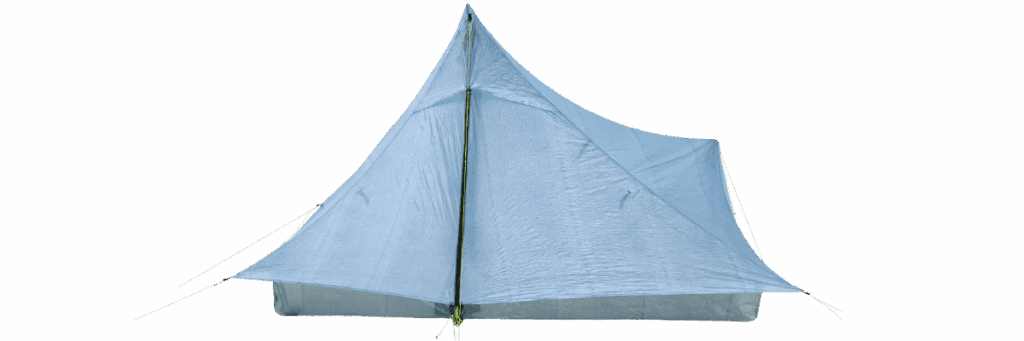
Price: $649 | Weight: 13.5 oz (383 g), Lite version | Capacity: 1 person | Setup: 2 trekking poles at different heights, non-freestanding | Fabric: DCF
The Pivot Solo uses an unusual pitch, a full height pole at the head and a shorter pivoted pole at the rear corner, to open up far more head and foot room than a typical single pole shelter. The payoff is real interior livability at under 14 ounces, which is an excellent trade for anyone who does not mind a slightly more involved pitch. It replaced the older Offset Solo in Zpacks’ lineup and improved on it in nearly every way.
Best for: experienced solo backpackers chasing a sub-9-pound base weight who still want room to sit up and store gear inside.
Skip it if: you are brand new to trekking pole tents. The asymmetric pitch takes more practice to get taut than a standard A-frame design, so a beginner may want to start with something simpler first.
7. Nemo Hornet Elite OSMO 1P: Best Semi-Freestanding Ultralight Tent

Price: $549.95 | Weight: 1 lb 7 oz minimum (657 g), 1 lb 13 oz packed (812 g) | Capacity: 1 person | Setup: included aluminum poles, no trekking poles required | Fabric: OSMO nylon/polyester blend, double wall
The Hornet Elite OSMO 1P is the tent for readers who do not want to learn a trekking pole pitch at all. It comes with its own DAC Featherlite poles, sets up in the same familiar way as a standard backpacking tent, and still comes in under two pounds packed. Nemo’s OSMO fabric resists stretching when wet far better than older nylon fabrics, which means less midnight retensioning in the rain. It is a double wall design too, so condensation management is easier for beginners than the single wall DCF shelters above.
Best for: beginners, hikers who do not use trekking poles, and anyone who wants a familiar double wall setup at an ultralight weight. See how it compares to the standard Hornet OSMO in this Hornet 1P vs. Elite breakdown.
Skip it if: you want the lightest possible solo shelter and do not mind a trekking pole pitch, since the X-Mid Pro 1 and Pivot Solo above both weigh noticeably less.
8. Hyperlite Mountain Gear Mid-1: Best Low-Weight Design

Price: $599 | Weight: 16.8 oz (476 g) | Capacity: 1 person | Setup: single trekking pole, non-freestanding | Fabric: DCF
The HMG Mid-1 is a pyramid style shelter that scales down the brand’s long running UltaMid design to solo size, and the simplicity is the point. One pole, one door, a fully enclosed bug proof interior, and a design that is quick to pitch and notably stable in wind since there is no complex geometry to fight with. It is one of the lightest fully enclosed single pole shelters available, which is why it earns the low-weight design category over more feature-heavy options.
Best for: minimalists who want the simplest possible pitch and do not need extra vestibule space or dual doors.
Skip it if: you want more usable floor space beside your sleeping area, since the steep pyramid walls eat into livable width more than a bathtub floor design.
9. Gossamer Gear The One: Best Lightweight One-Person Silnylon Tent

Price: $629 | Weight: 22.2 oz total (630 g) | Capacity: 1 person | Setup: 2 trekking poles, non-freestanding | Fabric: ClearSkies nylon ripstop, silicone and PU coated
The The One has been a long time favorite for hikers who want a silnylon tent instead of DCF, and the 2026 update to Gossamer Gear’s ClearSkies fabric bumped up both waterproofing and tear resistance without adding meaningful weight. It has excellent headroom for a solo shelter, both doors open for cross ventilation, and it pitches easily once you have the basic trekking pole technique down.
Best for: solo hikers who prefer the durability and lower cost of silnylon over Dyneema, and anyone who has already gotten comfortable with a trekking pole pitch.
Skip it if: you want the lightest possible option at this price point, since the DCF shelters above shave several ounces for a similar cost.
10. Gossamer Gear The Free: Best Affordable Freestanding Tent
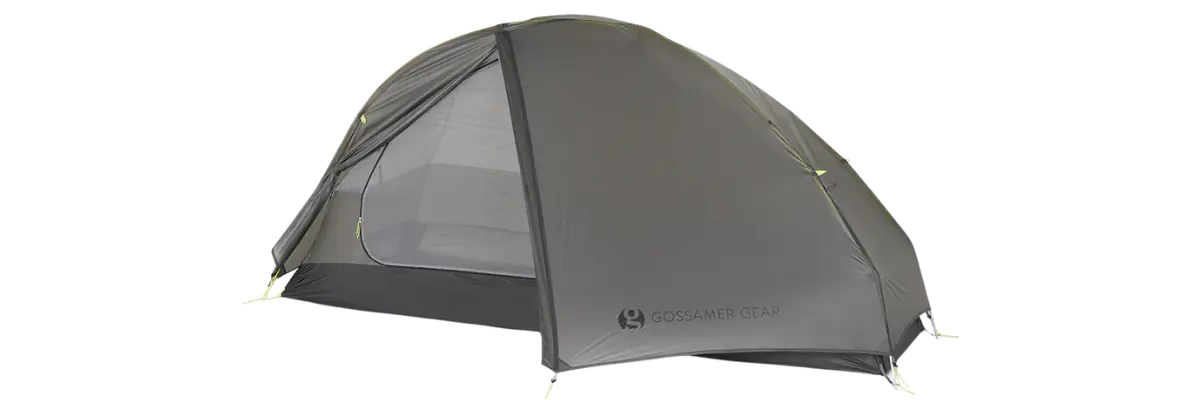
Price: $400 | Weight: around 2 lb (900 g) with stakes | Capacity: 1 person | Setup: included aluminum poles, fully freestanding, no stakes required | Fabric: ClearSkies silnylon, double wall
The The Free is Gossamer Gear’s first fully freestanding tent, and it fills a real gap in the market: a freestanding double wall shelter that does not cost as much as a full DCF setup. It can pitch on rock, sand, or a wooden tent platform without a single stake, which matters a lot if you camp anywhere with unreliable ground.
Best for: hikers who camp in places where staking out a tent is difficult, and anyone who wants freestanding convenience without paying DCF prices for it.
Skip it if: interior space is a priority, since the floor tapers down to just 21.5 inches at the foot, noticeably tighter than the trekking pole options above.
11. Hyperlite Mountain Gear CrossPeak 1: Best Ultralight Freestanding One-Person Tent
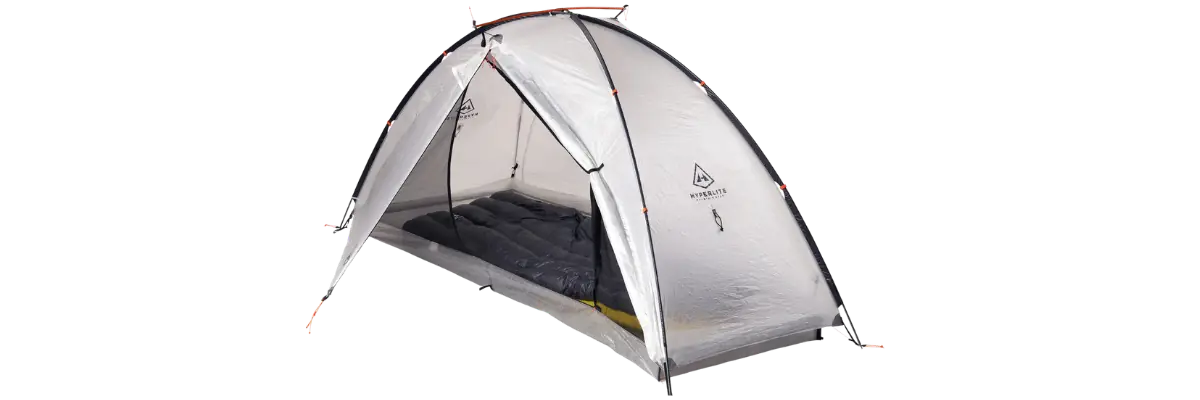
Price: around $825 | Weight: 28.7 oz (813 g) | Capacity: 1 person | Setup: included DAC aluminum poles, fully freestanding | Fabric: DCF, single wall
The CrossPeak 1 is proof that freestanding and ultralight are not mutually exclusive anymore. It pitches almost anywhere, rocky ground, tent platforms, sand, without needing a single stake to hold its shape, and it still comes in under two pounds. That is genuinely impressive engineering, but it is also the most expensive one-person tent on this list by a wide margin.
Best for: alpine climbers, high route hikers, or anyone who regularly camps somewhere stakes will not hold and who has the budget for it.
Skip it if: you camp on normal dirt and grass most of the time, since a stake-friendly trekking pole tent will get you similar weight for hundreds of dollars less.
12. Hyperlite Mountain Gear CrossPeak 2: Best Ultralight Freestanding Two-Person Tent
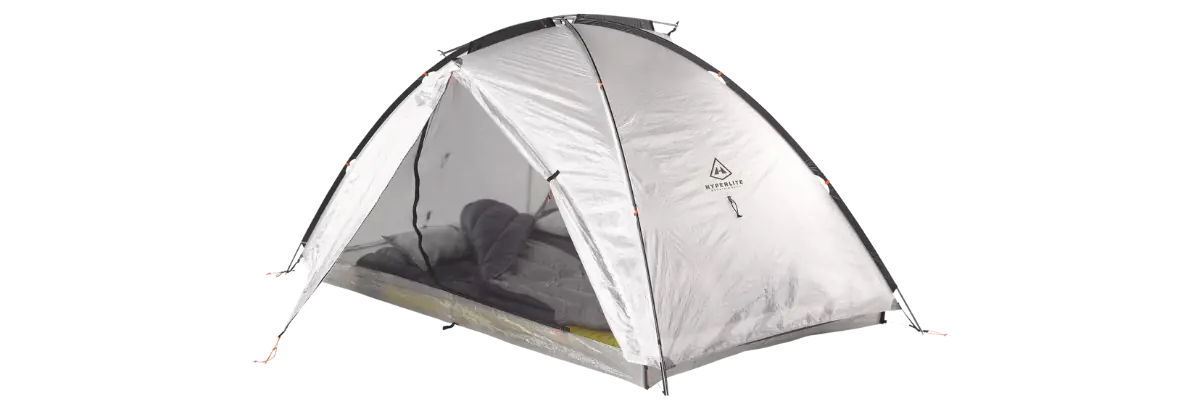
Price: around $950 | Weight: 34 oz (964 g) | Capacity: 1 to 2 person | Setup: included DAC aluminum poles, fully freestanding | Fabric: DCF, single wall
The CrossPeak 2 closes out this list at the bottom for a simple reason: it is a fantastic tent for a very narrow use case and a poor value for almost everyone else. At just over two pounds it is remarkably light for a freestanding two person shelter, and the single wall DCF construction sheds serious weight compared to a traditional double wall freestanding tent. But that single wall design means more condensation directly against the interior, and at nearly $950 it is priced well above every other tent here.
Best for: mountaineers and high route parties who genuinely need a freestanding two person shelter for exposed alpine terrain.
Skip it if: you are a beginner, camp mostly on established trails, or are price sensitive at all. Nearly every other tent on this list will serve a typical backpacker better for less money.
How to Actually Choose Between These
If you take nothing else from this guide, use this order of questions instead of just sorting by weight:
- Do you already own trekking poles? If not, the Double Rainbow, Hornet Elite OSMO, The Free, or either CrossPeak let you skip buying a separate set of tent poles.
- What is your actual budget? If you are under $400, the Double Rainbow and The Two are the two tents on this list actually worth considering.
- How many people need to fit inside? Solo hikers have the most options here. Duos should start with the Duplex Classic or X-Mid Pro 2+.
- Is this your first ultralight tent? Start with a double wall or semi-freestanding option before jumping into a single wall DCF trekking pole tent.
Frequently Asked Questions
Do I need trekking poles for an ultralight tent?
Only for non-freestanding designs like the Duplex, both X-Mid Pro models, the Pivot Solo, and The One and The Two. If you do not hike with trekking poles already, look at the Double Rainbow, Hornet Elite OSMO, The Free, or either CrossPeak instead, since all of those come with their own poles. Read more in our guide to using trekking poles for a tent.
Is Dyneema (DCF) worth the extra cost over silnylon?
It depends on your priorities. DCF is lighter and does not sag or absorb water the way silnylon can, but it costs significantly more and is more prone to punctures. Silnylon options like the Double Rainbow and Gossamer Gear’s One and Two get you 80 to 90 percent of the weight savings for a fraction of the price. Our full breakdown of Dyneema vs. silnylon and whether Dyneema tents are worth it go deeper into the tradeoffs.
Are ultralight tents durable enough for regular use?
Most of the tents on this list will last for years of regular three season use if you take basic care of them, use a groundsheet on rough terrain, and store them dry. DCF shelters trade some abrasion resistance for weight savings, while silnylon and silpoly options like the Double Rainbow tend to be more forgiving of rough handling. For a full answer, see are ultralight tents durable.
What does semi-freestanding actually mean?
A semi-freestanding tent, like the Nemo Hornet Elite OSMO 1P, holds its main shape once the included poles are connected, but the vestibule and full tension still require a few stakes. It is a middle ground between a fully freestanding tent that needs zero stakes and a trekking pole tent that needs a taut, staked pitch to hold any shape at all.
Should a beginner buy a DCF tent or a silnylon tent first?
Silnylon or silpoly is generally the smarter first purchase. It costs less, tolerates mistakes better while you are still learning to pitch a taut shelter, and gets you most of the weight savings anyway. Once you know exactly how you camp and what you actually need from a shelter, upgrading to DCF makes a lot more sense.
How much should my first ultralight tent cost?
Plan on somewhere between $300 and $650 for a solid first ultralight shelter. Anything under $300 usually means real compromises in weather resistance or durability, and you do not need to spend $700-plus on Dyneema until you know exactly what you want out of a tent.



