

Altaplex Pro Quick Take
The Altaplex Pro is built for tall solo hikers and thru-hikers who want a single-pole Dyneema shelter with real headroom and a feature set that the bare-bones Zpacks tents skip. Its standout strength is the combination of a 56 to 58 inch peak height and a 90 inch floor in a tent that weighs about 14.5 ounces, which is rare air for a fully enclosed, floored shelter. The main tradeoff is that all of that vertical real estate sits on one trekking pole, so the pitch lives and dies by your stakes, and the price is steep even by DCF standards. If you sleep tall, value sitting-up room, and camp mostly in three-season weather, this is one of the easiest single-pole tents to recommend.
Pros
- Tall peak and long floor that genuinely fit hikers up to and past 6 feet 4 inches
- Feature-rich for an ultralight DCF tent, with zippered storm doors, a peak vent, magnet toggles, and a double-L zipper
- DCF does not sag or absorb water, so the pitch you set at dusk is the pitch you wake up to
- Roughly 14.5 ounces for the Lite floor build, with a small packed size
Cons
- One of the most expensive one-person tents on the market at 749 dollars
- Single-pole design relies entirely on good stake placement, and one pulled stake can drop the whole tent
- You really want 10 stakes to open up the interior, not the 6 minimum
- Only one interior pocket, and the tall profile adds wind-facing surface area
Bottom line: a 749 dollar, roughly 14.5 ounce, one-person single-wall DCF tent that trades storm-proof bracing for unmatched headroom and livability.

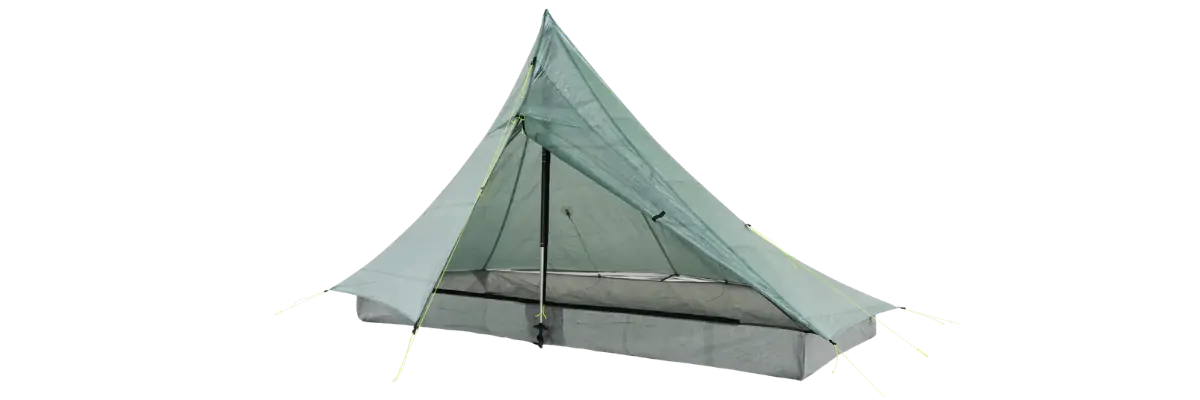
Specs at a Glance: Altaplex Pro
| Spec | Detail |
|---|---|
| Price (USD) | 749 dollars |
| Trail Weight | 412 g / 14.5 oz (Lite floor). 485 g / 17.1 oz (Standard floor) |
| Packed Weight | About 429 g / 15.1 oz (Lite, including stuff sack, repair tape, and spare sliders) |
| Capacity | 1 person |
| Floor Dimensions | 90 in x 40 in (229 cm x 102 cm), about 25 sq ft |
| Peak Height | 56 to 58 in (142 to 147 cm) |
| Packed Size | About 4.5 in diameter x 11 in tall rolled tight (11.5 cm x 28 cm), 175 cu in / 2.9 L. Stuff sack 6 in x 12 in |
| Shelter Type | Single-wall, single trekking pole, hybrid pyramid DCF tent |
| DCF Canopy Weight | 0.55 oz/sqyd (Lite) or 0.75 oz/sqyd (Standard) |
| DCF Floor Weight | 0.75 oz/sqyd (Lite) or 1.0 oz/sqyd (Standard) |
| Number of Doors | 1 front entry (double-L screen door with two independently operable zippered storm door panels) |
| Number of Vestibules | 1 front vestibule, with gear storage on both sides of the pole |
| Wall Construction | Single-wall canopy with integrated bathtub floor and perimeter insect netting |
| Season Rating | 3-season |
| Trekking Poles Required | Yes, 1 pole set to 56 to 58 in (142 to 147 cm). Pole, jack, or tent pole sold separately |
| Warranty | 2-year limited warranty against defects in materials and workmanship |
| Lead Time | Ships in 1 to 3 business days |
Zpacks Altaplex Pro Design and Build Quality
The Altaplex Pro is a larger, taller take on the Plex Solo, and the upgrades are where your money goes. The canopy comes in two grades of Dyneema Composite Fabric. The Lite build uses a 0.55 oz/sqyd canopy over a 0.75 oz/sqyd floor, while the Standard build steps up to a 0.75 oz/sqyd canopy and a 1.0 oz/sqyd floor for more opacity and abrasion resistance. DCF is inherently waterproof rated to 15,000 mm, so there are no coatings to wear off and the fabric does not soak up water weight in a storm.
Seams are taped and tie-outs are bonded, which means no seam sealing is required out of the box. Zippers are #3 YKK and the sliders are field-replaceable, with repair tape and two spare sliders included in the bag. That is a thoughtful touch on a tent you might take on a 2,500 mile hike.
The feature list is generous for an ultralight shelter: zippered storm doors, a peak vent, a double-L screen door, and magnet toggles that let you roll either door back one-handed. Guyout points use LineLoc V adjusters and bright 1.6 mm yellow Z-Line guylines that are easy to see at night. The bathtub floor is durable enough to skip a groundsheet, though a flat groundsheet is an optional add-on. The premium price is hard to swallow, but the materials and hardware justify most of it.
Setup and Pitch of the Altaplex Pro
This is the section where the Altaplex Pro earns its name. The interior floor measures 90 inches long by 40 inches wide, giving you about 25 square feet, and the peak hits 56 to 58 inches depending on how high you run your pole. That headroom is the whole point. You can sit fully upright, change clothes, and cook in the vestibule during a downpour without hunching.
Tall sleepers are the target buyer here. Reviewers at 6 feet 5 inches describe it as roomy rather than merely adequate, and hikers around 5 feet 11 inches find it close to palatial. The single-pole geometry does mean the steep walls eat into usable width as you move away from center, so the widest, tallest space is right under the peak.
The zipper entry stands 36 inches tall, which makes climbing in and out easy even with bulky layers. The front vestibule offers covered storage on both sides of the trekking pole, so a pack on one side and shoes on the other is a comfortable arrangement. Storage inside is leaner. There is a single integrated mesh pocket for a headlamp, glasses, or phone, and that is it. Side sleepers have plenty of length to stretch out diagonally. This is a one-person tent through and through, so do not expect two-person duty.
Weather Performance of the Zpacks Altaplex Pro
Single-pole tents reward practice, and the Altaplex Pro is no exception. The sequence is straightforward: stake the four corners, raise a single trekking pole to 56 to 58 inches at the peak, stake the front line, then tension the four wall tie-outs. Most people get a clean pitch in a few minutes once the routine clicks, but expect a learning curve over your first handful of nights to dial in symmetry and tension.
You need 6 stakes at a minimum, but plan to carry 10. The extra four open up noticeably more interior space and brace the tent in wind, and the three rear tie-outs in particular pull the back wall out for headroom and foot room. Skipping them on a budget defeats the purpose of buying a roomy tent.
DCF does not stretch, and that cuts both ways. The upside is that a taut pitch stays taut all night, even when wet, with none of the midnight re-tensioning that nylon demands. The downside is that DCF is unforgiving of a sloppy initial pitch, so if the fabric is wrinkled, you have to move stakes rather than wait for it to stretch into shape.
On uneven ground the single pole and four corners give you some flexibility to work around slope and rocks. If your trekking pole will not extend past 56 inches, you will need a pole jack, a dedicated 58 inch tent pole, or a fixed pole. It is beginner-friendly enough, just not as forgiving as a freestanding double-wall tent.
Zpacks Altaplex Pro Value and Comparisons
For a tall single-pole tent, the Altaplex Pro holds up better than its height suggests. Rain protection is excellent. DCF is waterproof without coatings, the seams are taped, and field reviews of the Altaplex line report no leaks through fierce storms and sustained rain. The overhanging canopy and a tall bathtub floor, roughly 8 inches on the previous generation, keep splash-up and runoff out of your sleeping space.
Wind is the honest caveat. The single-pole shape presents a thin profile when oriented end-on to the wind, which helps, but the tall peak also adds surface area, and the structure depends entirely on your stakes. Independent testing has noted that if a stake pulls in a strong gust, the whole tent can come down, so good stake placement and the full 10-stake setup matter in exposed terrain. Pitch one end upwind and close the upwind storm door for the best storm mode. Anecdotally, the Plex platform has bested some two-pole DCF competitors in 40-plus mph wind tests, so the shape is stronger than it looks when staked properly.
Condensation is the usual single-wall question, and the Altaplex manages it well. The tall pitch leaves gaps along the perimeter, the peak vent moves air, and the storm doors can be rolled back to create a cross breeze. Multiple testers report minimal to no condensation, even below freezing, thanks to that airflow. Leave at least one downwind door cracked unless the weather is genuinely nasty.
Altaplex Pro Value and Comparisons
At 749 dollars this is near the ceiling for a one-person tent, so the question is what you get for the premium and who should pay it.
Versus the Durston X-Mid Pro 1 (around 599 dollars, roughly 15.5 to 17.1 ounces). The X-Mid uses two trekking poles and an offset geometry that delivers two doors, two vestibules, and a famously fast, beginner-proof pitch with only four or five stakes. It is the easier tent to live with for most people and costs less. The Altaplex counters with a single-pole simplicity, a smaller footprint, and a much taller 56 to 58 inch peak compared to the X-Mid’s 45 inches. Choose the X-Mid if you want the easiest setup and the most forgiving design. Choose the Altaplex if sitting-up headroom and a compact footprint matter more than vestibule count.
Versus the Zpacks Plex Solo (around 599 dollars, roughly 12 to 14 ounces). This is the in-house sibling. The Plex Solo is lighter, cheaper, and simpler, but shorter and more spartan, with a 52 inch pole height and fewer comfort features. Go Plex Solo if you are not especially tall and want to save weight and money. Step up to the Altaplex Pro for the extra height, the storm doors, and the peak vent.
Versus the Tarptent ProTrail Li (around 17.7 ounces with stakes and bag, cheaper). Also a single-pole DCF solo tent, but lower and you have to crouch to enter. Pick the ProTrail Li to save real money on DCF. Pick the Altaplex for stand-up entry and more living volume.
Buy the Altaplex Pro if you are a tall solo backpacker or thru-hiker who wants maximum headroom and livability in a single-pole tent and is willing to pay top dollar and carry 10 stakes for it. If you prioritize easy setup, a lower price, or two true vestibules, the X-Mid Pro 1 is the smarter pick.
Altaplex Pro by Zpacks FAQ
Is the Zpacks Altaplex Pro good in the rain?
Yes. The DCF canopy is waterproof without any coating, the seams come taped from the factory, and the tall bathtub floor and overhanging canopy keep splash-up out. Long-term users of the Altaplex line report no leaks through heavy, sustained storms.
How does the Altaplex Pro handle wind?
Reasonably well for a tall single-pole tent, but with a clear catch. The thin end-on profile helps, yet the height adds wind-facing surface area and the structure depends entirely on your stakes. Use all 10 stakes, pitch one end into the wind, and close the upwind storm door in exposed conditions.
Is the Altaplex Pro hard to set up?
It has a mild learning curve. The four corners, single pole, and wall tie-outs are simple in principle, but DCF does not stretch, so a sloppy first pitch has to be fixed by moving stakes rather than waiting for the fabric to tension itself. Most people are pitching it cleanly within a few nights.
How many stakes do I need for the Altaplex Pro?
Six is the bare minimum to get it standing, but 10 is the real answer. The extra stakes pull out the walls and rear tie-outs for noticeably more interior room and add critical stability in wind. Stakes are not included.
Is the Altaplex Pro good for tall people?
This is arguably its best trait. The 90 inch floor and 56 to 58 inch peak make it one of the roomiest single-pole solo tents available, and hikers at 6 feet 4 inches and taller report comfortable fit and full sitting headroom.
Does the Altaplex Pro have condensation problems?
Less than you might fear from a single-wall tent. The tall pitch, perimeter gaps, peak vent, and roll-back storm doors keep air moving, and many testers report little to no condensation even in near-freezing temperatures. Leave a downwind door cracked when the weather allows.
Do I need a groundsheet with the Altaplex Pro?
No, the floor is durable enough to use on its own. A flat groundsheet is an optional precaution if you camp on rough or abrasive ground and want to extend the floor’s life.