

Skyscape Trekker Quick Take
The Skyscape Trekker is Six Moon Designs’ answer for hikers who feel cramped in most solo ultralight shelters, especially anyone over six feet tall. Its standout strength is sheer interior length combined with two full doors and two vestibules, which is unusual at this weight and price. The main tradeoff is that some of that extra room and dual-entry convenience comes with narrower vestibules than you’d get from a single-door design, and the hybrid double wall construction means you’re carrying a bit more fabric than the simplest single-wall pyramids. It’s a trekking pole shelter, so you’ll need poles or SMD’s optional tent poles to pitch it.
Pros:
- Genuinely long floor (over 8 feet), great for tall hikers who touch both ends of most solo tents
- Two doors and two vestibules for easy access and gear storage on both sides
- Mesh-heavy hybrid double wall keeps condensation off your quilt better than single-wall designs
- Rigid, storm-capable pitch thanks to the offset dual-pole structure
Cons:
- Vestibules are narrower than the total square footage suggests
- Seams are not pre-sealed, so budget time or money for that step
- Manufacturer’s own marketing copy and spec sheet list two different weights, so verify before you buy
- Heavier than the newest single-wall competitors in this price range
One-line summary: At $275, roughly 26 to 28 ounces trail weight, and room for one (plus gear), the Skyscape Trekker is a roomy, well-ventilated solo shelter built for hikers who value space over shaving the last few ounces.


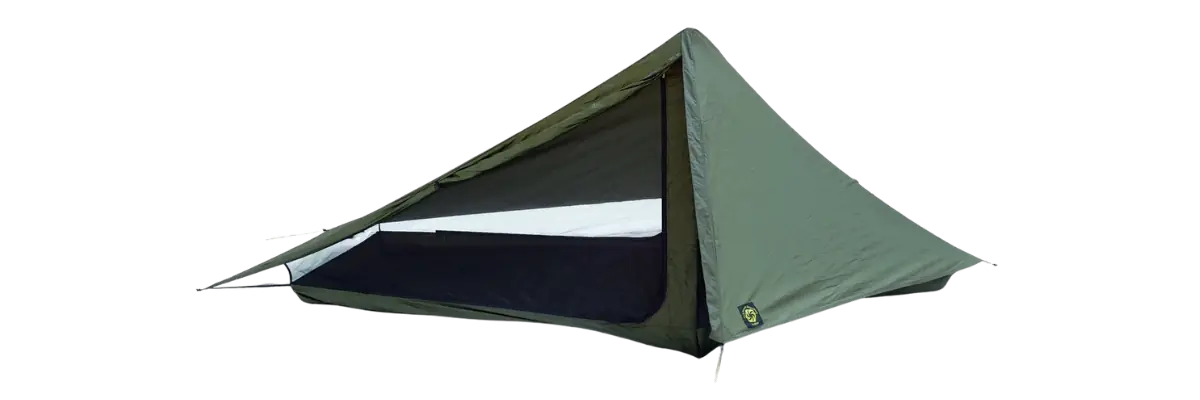
Specs at a Glance: Skyscape Trekker
| Spec | Detail |
|---|---|
| Price (USD) | $275 (plus optional $10 to $35 seam sealing service) |
| Trail Weight | 740 g / 26 oz (per manufacturer spec table; SMD’s own marketing copy elsewhere lists 790 g / 28 oz) |
| Packed Weight | Not specified separately from trail weight |
| Capacity | 1 person (SMD lists it as “1+”) |
| Floor Dimensions | Approximately 101 to 103 in x 42 to 48 in (257 to 262 cm x 107 to 122 cm); independent measurements and retailer listings disagree, see note below |
| Peak Height | 42 to 45 in (107 to 115 cm), depending on source |
| Packed Size | 11 in x 4.5 in / 28 cm x 11 cm |
| Shelter Type | Trekking pole tent, hybrid double wall |
| Shelter Material | 100% silicone coated polyester (Silpoly) |
| Canopy Weight | Not specified (20 denier fabric) |
| Floor Weight | Not specified (40 denier fabric) |
| Number of Doors | 2 |
| Number of Vestibules | 2 (8 sq ft / 0.7 sq m each, 16 sq ft / 1.4 sq m total) |
| Wall Construction | Hybrid double wall with bathtub floor; roughly 80% mesh interior separates you from the fly |
| Season Rating | 3-season |
| Trekking Poles Required | 2, at 45 in / 115 cm each (or SMD’s aluminum or carbon fiber tent poles, sold separately) |
| Warranty | Lifetime warranty to the original owner against manufacturing defects |
| Lead Time | Ships within 1 business day if in stock; add 1 to 2 business days if you choose SMD’s seam sealing service |
SMD Skyscape Trekker Design and Build Quality
The Trekker is built from 100% silicone coated polyester, sometimes called Silpoly, with a 20 denier canopy and a 40 denier floor. That floor upgrade matters. Six Moon Designs uses the heavier fabric specifically to handle abrasion and repeated staking without the punctures that plague some ultralight floors. Silpoly’s other advantage is that it resists stretching when wet, so you won’t wake up to a saggy fly after a rainy night the way you might with uncoated silnylon.
Hardware is kept simple and functional: a #3 YKK zipper on the main door, a 3,000 mm hydrostatic head rating on the canopy, and 1.8 mm cord rear guyouts that Six Moon Designs added specifically to boost interior height at the foot end and improve rear ventilation. The bathtub floor and dual offset pole structure are the real engineering story here. Instead of centering the pole line, SMD shifts it slightly, which increases headroom when you’re lying down and reduces that boxed-in feeling common to single-pole shelters.
Given the roughly $275 price, you’re not paying Dyneema money, and the build reflects that. This is a well-executed silpoly shelter, not a premium composite one, and the price tracks accordingly against competitors using similar fabrics.
Setup and Pitch of the Skyscape Trekker
This is where the Trekker earns its reputation. The floor stretches past 8 feet, translating to a claimed length of roughly 100 to 103 inches depending on the source, which is genuinely rare in a solo shelter. Independent measurements put the usable floor width at 42 inches at its widest point, tapering to about 32 inches at the foot end, since the floor is shaped like an elongated pentagon rather than a simple rectangle.
Peak height is listed at 45 inches by Six Moon Designs and its retail partners, though at least one independent reviewer measured closer to 42 inches under the ceiling strut. Either way, there’s enough room to sit up fully, change clothes, and dig through a pack without crouching. Tall sleepers, meaning anyone in the 6’2″ to 6’4″ range, consistently report in owner reviews that this is one of the only solo shelters where their head and feet don’t touch both ends.
The two side-entry doors each open onto their own 8 square foot vestibule, giving you gear storage on both sides rather than fighting over one entrance. Vestibules run narrower than the square footage suggests, so expect enough room for a pack and shoes rather than a full kitchen setup. There’s a built-in stash pocket for small items, but this isn’t a two-person tent despite the interior volume. It’s a wide, long one-person shelter.
Weather Performance of the SMD Skyscape Trekker
The Trekker pitches with two 45 inch (115 cm) trekking poles, or with Six Moon Designs’ own aluminum or carbon fiber tent poles if you don’t hike with poles. Owner reviews consistently mention a real learning curve on the first attempt, followed by a fast, confident pitch once you’ve practiced it a few times. Several reviewers specifically mention rehearsing in a backyard or on uneven ground before their first trail night, and reporting an easy setup after a full day of hiking once they had the sequence down.
Stake count sits around 5 to 6 stakes, which SMD sells separately. The silpoly fabric has low stretch compared to silnylon, which is a real practical benefit: once you get a taut pitch, it tends to stay taut through the night and through temperature and humidity swings, rather than sagging by 2 a.m. and needing a re-tension.
On uneven ground, the offset dual-pole structure and the ability to independently adjust each vestibule give you more flexibility than a single-pole pyramid, since you’re not locked into one symmetrical footprint. That said, this is still a trekking pole shelter with multiple guy points, so it demands more attention to stake placement and guyline tension than a freestanding pole tent. Budget a few practice pitches at home before you rely on it in the field, and expect the process to click faster than you’d expect once you understand the geometry.
SMD Skyscape Trekker Value and Comparisons
Six Moon Designs designed the offset dual-pole frame specifically for rigidity in bad weather, and real-world reports back that up. One long-term reviewer used the Trekker in sustained 40 mph winds with higher gusts on the Pacific Crest Trail and reported no structural issues. Another owner rode out a storm with 50-knot winds and heavy, sustained rain over a multi-day stretch and noted the tent held its shape, though wind-driven rain did find its way through the mesh in the worst gusts, a fair-weather-mesh-tradeoff worth knowing about going in.
Condensation management is a genuine strength of the hybrid double wall design. Because roughly 80% of the canopy sits behind mesh rather than direct fabric, moisture that collects on the fly’s interior mostly stays off your body and gear. That said, it isn’t perfect. Multiple owners report some condensation transfer to a sleeping bag or quilt near the foot end, where the ceiling narrows and there’s less mesh buffer, though everyone describes it as minor and easily dried out by morning.
Ventilation is excellent when both vestibules are rolled back, turning the Trekker into something close to a net tent on warm nights. The bathtub floor and adjustable vestibules give you storm mode options, but at least one detailed long-term reviewer suggested the outer walls could extend closer to the ground with a taller inner mesh wall to further reduce wind-driven splash-in during the heaviest storms. It’s a minor structural critique, not a dealbreaker, but worth factoring in if you expect frequent exposed, high-wind camping.
Skyscape Trekker Value and Comparisons
At $275, the Trekker sits in the same rough price bracket as its closest rivals, but the comparisons reveal real tradeoffs rather than a clear winner.
Against Six Moon Designs’ own Lunar Solo ($260, 26 oz / 740 g), the Trekker trades some of the Lunar Solo’s simplicity and slightly larger total floor area (26 sq ft versus 23 sq ft) for two doors instead of one, better condensation control thanks to the hybrid double wall, and significantly more usable length for tall hikers. If you’re under six feet and want the simplest, cheapest, most proven SMD shelter, the Lunar Solo is the better call. If you’re tall or want dual entry, the Trekker justifies its position as the step up.
Against the Durston X-Mid 1 ($269, roughly 25 oz / 720 g), the comparison is closer. The X-Mid 1 is broadly regarded as one of the best all-around values in ultralight solo tents right now, with a genuinely fast, near-foolproof pitch, similar dual-door and dual-vestibule setup, and comparable or better weather resistance thanks to its rectangular offset-pole geometry. The Trekker’s advantage is raw floor length for very tall hikers; the X-Mid 1’s advantage is a shorter learning curve and a design that’s earned a broader reputation for wind performance in recent testing.
Against Gossamer Gear’s The One (a lighter, single-door, single-wall pyramid style shelter), the Trekker gives up some weight savings in exchange for two doors, two vestibules, and meaningfully better condensation management. If minimizing grams is your only priority and you’re comfortable with single-wall condensation tradeoffs, The One pulls ahead on weight alone.
Bottom line: choose the Trekker if you’re tall, want dual-door convenience, and prioritize a dry night over shaving the last few ounces. Choose the X-Mid 1 if you want the easiest possible pitch and the strongest current reputation for storm performance at a similar price. Choose the Lunar Solo if budget and simplicity matter more than length or dual entry.
Skyscape Trekker by Six Moon Designs FAQ
Is the Skyscape Trekker good in rain and wind? Yes, generally. Owners report it holding up in sustained 40 mph winds and multi-day storms with 50-knot gusts, though the mesh interior can allow some wind-driven rain through in the worst conditions.
Is the Skyscape Trekker hard to set up? There’s a real learning curve the first few times, especially on uneven ground, but most owners describe a fast, reliable pitch once they’ve practiced the sequence a handful of times at home.
What season is the Skyscape Trekker rated for? It’s a 3-season shelter. It isn’t designed as a dedicated winter or heavy snow-load tent, though the rigid dual-pole frame handles occasional snow and cold-weather wind reasonably well.
Does the Skyscape Trekker get condensation? Some, but less than most single-wall shelters. The hybrid double wall’s mesh interior keeps most fly-side condensation off your gear, though a few owners note minor moisture transfer near the foot end where the ceiling narrows.
Is the Skyscape Trekker worth it for tall hikers? This is one of its main selling points. With a floor stretching past 8 feet, hikers in the 6’2″ to 6’4″ range consistently report being the first solo shelter where they don’t touch both ends.
Does the Skyscape Trekker need a footprint? Six Moon Designs sells a matching groundsheet separately, and it’s worth considering given the 40 denier floor faces more abrasion risk than a Dyneema floor, though many owners run it without one on established trail campsites.
Do I need trekking poles to set up the Skyscape Trekker? You need two 45 inch (115 cm) poles. If you don’t hike with trekking poles, Six Moon Designs sells dedicated aluminum or carbon fiber tent poles as an add-on.