

X-Mid 2 Quick Take
The Durston X-Mid 2 is the tent most ultralight backpackers try before they buy anything more expensive, and a lot of them never leave it. It’s a trekking-pole-supported, double-wall shelter that trades a few ounces for real livable space, genuine storm performance, and a price that undercuts nearly everything in its weight class. The standout strength is the geometry: an offset, diagonal pole layout that squeezes more headroom and floor space out of the same fabric footprint as a standard A-frame design. The main tradeoff is size. This is a big tent on the ground, and its two-pole, guyed-out footprint can be awkward to place on small or rocky sites.
Pros
- Exceptional interior space and headroom for the weight class
- Genuinely storm-worthy shape with a full-coverage fly and dual vents
- Simple four-stake pitch with no mandatory guylines
- Direct-to-consumer pricing that undercuts cottage and DCF competitors
Cons
- Large footprint makes tight or rocky campsites harder to work with
- Interior pocket count is modest for a tent this size
- Nylon floor (rather than polyester) can still absorb some moisture and sag slightly compared to the fly
- Not the lightest option if shaving every last ounce is the only priority
One-line summary: At $319, roughly 31.3 oz (890 g) trail weight, and 2-person capacity, the X-Mid 2 remains one of the best value-to-performance ultralight tents on the market.
Specs at a Glance: X-Mid 2
| Spec | Durston X-Mid 2 |
|---|---|
| Price (USD) | $319 |
| Trail Weight | 31.3 oz / 890 g (fly 18.8 oz / 535 g + inner 12.5 oz / 355 g) |
| Packed Weight | 34.3 oz / 975 g (tent, stuff sacks, and 6 of the 8 included stakes) |
| Capacity | 2-person |
| Floor Dimensions | 92 x 52 in / 234 x 132 cm |
| Peak Height | 48 in / 122 cm |
| Packed Size | 12 x 6 in / 30 x 15 cm |
| Shelter Type | Trekking-pole-supported, double-wall |
| Shelter Material | 15D Sil/PE polyester fly, 15D Sil/PE nylon floor |
| Canopy Weight (oz/sqyd) | Not specified on current product page (15D silpoly, 3,500 mm HH rating) |
| Floor Weight (oz/sqyd) | Not specified on current product page (15D nylon, 3,500 mm HH rating) |
| Number of Doors | 2 |
| Number of Vestibules | 2 (11.5 sq ft each) |
| Wall Construction | Full double wall, full-coverage fly, fly-first pitch |
| Season Rating | 3-season |
| Trekking Poles Required | Yes, 2 (exact recommended pole length not published; adjustable poles work best) |
| Warranty | 2 years |
| Lead Time | Not specified (listed as in stock at time of writing) |
Durston Gear X-Mid 2 Design and Build Quality
The X-Mid 2 is built around Durston’s patented offset-pole geometry, and the construction backs up the ambition of that design. The fly uses a 15D silicone/polyurethane-coated polyester rated to 3,500 mm hydrostatic head, chosen specifically because polyester doesn’t absorb water and sag the way nylon does through the night. The floor, by contrast, uses a 15D silnylon at the same waterproof rating, a deliberate tradeoff that favors floor durability and abrasion resistance over the fly’s non-sag behavior. Seams are factory taped rather than left for the user to seal, which is unusual at this price point and saves you an evening with a tube of seam sealant.
Hardware is where the premium positioning shows up most clearly. Durston specs YKK #5 AquaGuard zippers on the fly, a heavier-duty option than the #3 zippers common on lighter competitors, because zippers are the most common failure point on a trekking pole tent. Inner zippers step down to YKK #3, which is reasonable since they aren’t exposed to weather. You also get double stitching, double-folded edges, high-precision narrow seams, and generous bartacking throughout. Magnetic door toggles and eight DAC J-stakes round out the package. This is a tent built to be used hard, not just carried light.
Setup and Pitch of the X-Mid 2
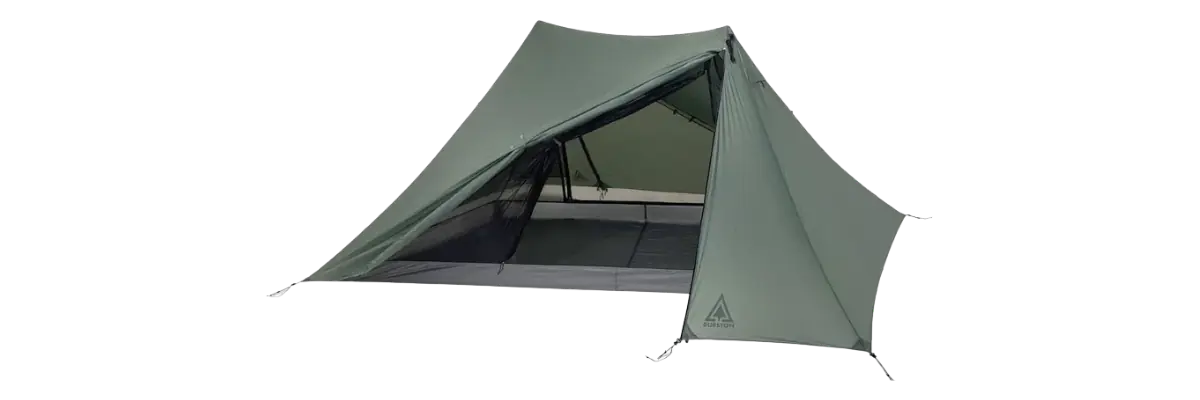
This is the section where the X-Mid 2 earns its reputation. The floor measures a genuine 92 x 52 inches, and Durston’s diagonal ridgeline design means headroom isn’t evenly distributed the way it is in a standard A-frame. One diagonal of the tent has notably more peak height clearance than the other, which the manufacturer says accommodates sleepers up to 6’4″ on the generous side and up to 6’0″ on the more typical side. Used solo, the parallelogram floor gives one extra-long diagonal that Durston recommends for hikers up to 7 feet tall.
For two people, you don’t need to sleep head-to-toe in opposite directions unless you’re both over 6’4″; you can both lie the same direction and still get workable headroom, with the person on the shorter side sliding down slightly to use the low corner for gear rather than their head. Shoulder room at 52 inches wide is genuinely comfortable for two wide sleeping pads side by side. The dual vestibules, at 11.5 square feet each, sit beside the doors rather than blocking them, so you can dig through a pack without leaning over your tentmate. Interior storage is four pockets: two side pockets and two peak pockets, useful for a headlamp or phone but not a lot of gear organization beyond that.
Weather Performance of the Durston Gear X-Mid 2
Durston designed the X-Mid 2 around a simple four-stake pitch, and that simplicity is real. There are no mandatory guylines, no odd angles to measure, and no struts to fuss with. Most reviewers and the manufacturer both cite a setup time around five minutes once you know the sequence, and the fly-first design means the inner tent stays clipped in and dry even if you’re pitching in active rain.
The learning curve is still worth naming honestly. The diagonal geometry is not intuitive the first time you lay the tent out, and new users typically need one or two practice pitches in the yard before it clicks in the field. Once you have the pattern down, it’s fast and repeatable. Trekking poles support the two peaks; Durston doesn’t publish an exact recommended pole length on the current product page, so if you’re buying poles specifically for this tent, check their pitching guide or contact support before ordering.
On uneven ground, the extra stake points (eight beyond the four required) let you tension the tent asymmetrically to work around roots, rocks, or slopes better than more rigid freestanding designs. Because the fly is polyester rather than nylon, it doesn’t stretch and sag as the night gets dewy, so a pitch that’s taut at 7 p.m. is usually still taut at 6 a.m., which is a genuinely beginner-friendly trait since you’re not out there re-tensioning stakes at 2 a.m.
Durston Gear X-Mid 2 Value and Comparisons
Durston built the X-Mid shape around a specific idea: keep every panel at a moderate 50 to 55 degree slope so the tent handles both wind and snow reasonably well, instead of optimizing for one at the expense of the other. In practice, this shows up as a tent that sheds wind gusts from multiple directions without the sidewalls slapping flat the way steeper-walled competitors can, and independent testers have generally rated it as one of the more storm-capable shelters in its weight class, though Durston doesn’t publish a specific mph wind rating.
The full-coverage fly extends low to the ground, which blocks wind-driven rain and splatter better than the high-cut flies used by many lighter competitors, at some cost to ventilation in warm, still conditions. Dual adjustable peak vents help manage condensation, and the double-wall design means any condensation that does form collects on the fly rather than dripping directly onto you or your gear, which single-wall DCF tents can’t fully avoid. Reviewers consistently note good condensation control for a tent this size, though no double-wall mesh tent is condensation-proof in cold, humid, no-wind conditions.
The bathtub floor and factory-sealed seams mean you shouldn’t need to seam-seal or worry about ground moisture wicking through under normal use, provided you avoid pitching directly on sharp gravel or exposed roots.
X-Mid 2 Value and Comparisons
At $319, the X-Mid 2 sits in an interesting spot: heavier and less exotic than Dyneema shelters, but noticeably cheaper and more feature-rich than most tents at a comparable weight. Two of the most common comparisons are the Zpacks Duplex and the Tarptent Stratospire 2.
The Zpacks Duplex Classic runs about $699 and uses Dyneema Composite Fabric to hit a trail weight in the neighborhood of 18.5 oz, dramatically lighter than the X-Mid 2. But that weight savings comes from a single-wall design (worse condensation management), no zippered doors on the base model, and a material that’s more puncture-prone than silpoly or silnylon. If your priority is the lowest possible pack weight and you’re willing to pay a premium and baby the fabric, the Duplex wins. If you want a tent you can be a little careless with on a rocky campsite and still trust for years, the X-Mid 2 is the more forgiving choice, at less than half the price.
The Tarptent Stratospire 2 is the closer philosophical match: similar trekking-pole geometry, similar double-wall construction, priced around $299 to $329 depending on the interior option. It’s heavier, at roughly 2 lb 11.8 oz packaged compared to the X-Mid 2’s lighter current spec, and its asymmetrical design has a steeper learning curve to pitch taut. The X-Mid 2 generally wins on weight, ease of pitching, and included seam sealing, while the Stratospire 2 offers a slightly larger vestibule option on some configurations and has a long track record with cottage-industry loyalists.
Buyer profile fit: choose the X-Mid 2 if you want the best balance of space, storm performance, and price without stepping into Dyneema pricing. Choose the Duplex if ounces are your only currency and budget isn’t a constraint. Choose the Stratospire 2 mainly if you already prefer Tarptent’s build philosophy or need a specific feature it offers that the X-Mid 2 doesn’t.
X-Mid 2 by Durston Gear FAQ
Is the Durston X-Mid 2 good in heavy rain? Yes. The full-coverage fly, factory-taped seams, and bathtub floor are specifically designed to handle sustained rain, and the fly-first pitch keeps the inner tent dry even if you’re setting up during a downpour.
Is the X-Mid 2 hard to set up? Not once you’ve practiced it, but expect a slight learning curve on your first pitch or two because of the diagonal, offset-pole geometry, which is different from a standard A-frame trekking pole tent.
What size trekking poles do I need for the X-Mid 2? Durston’s current product page doesn’t publish an exact recommended pole length. Adjustable trekking poles are recommended so you can fine-tune the pitch; check Durston’s pitching guide before buying dedicated tent poles.
Does the X-Mid 2 have condensation problems? Less than most single-wall ultralight shelters. The double-wall design and dual adjustable peak vents help manage condensation, though no mesh double-wall tent fully eliminates it in cold, still, humid conditions.
Can two people comfortably sleep in the X-Mid 2, or do they need to sleep head-to-toe? Two people can sleep the same direction comfortably in most conditions. Durston recommends sleeping in opposite directions only if both people are taller than 6’4″, since the diagonal ridgeline distributes headroom unevenly across the tent.
Is the X-Mid 2 too big for small campsites? It has a larger footprint than more compact ultralight tents, which can occasionally limit site options on trails with tight, established tent pads. Durston notes you can collapse the vestibules to shrink the footprint if needed.
Do I need a groundsheet with the X-Mid 2? Not for normal use. The 15D floor fabric is durable enough on typical dirt, sand, or grass sites, but Durston recommends care (or an optional groundsheet) on harsher surfaces like gravel, pine needles, or exposed bedrock.