

Lanshan 2 Quick Take
The Lanshan 2 is the tent most budget-conscious backpackers try first before they commit to the ultralight rabbit hole. It’s a double-wall, two-person, trekking-pole shelter that costs a fraction of what boutique cottage brands charge, and it does the basics well enough that thousands of thru-hikers and weekend campers have used it without complaint. The standout strength here is value: you get a genuine double-wall design, factory seam sealing, and two doors with two vestibules for well under $200. The tradeoff is fit and finish. The fly can sag if you don’t tension it just right, tall sleepers will find the floor a bit short, and quality control varies depending on which reseller ships your unit.
Pros
- Genuine double-wall construction that manages condensation better than most single-wall competitors at this price
- Comes seam-sealed from the factory, unlike the Pro version
- Two doors and two generously sized vestibules
- Packs down small and light for a double-wall shelter
Cons
- Interior can sag or billow if the pitch isn’t dialed in
- Tight for sleepers over 6 feet tall
- Included stakes are light-duty and not confidence-inspiring in soft or windy ground
- Reseller variance means seam sealing and materials quality aren’t always consistent
In short: around $158 direct from the manufacturer, roughly 43 oz (1,220 g) trail weight, sleeps two.

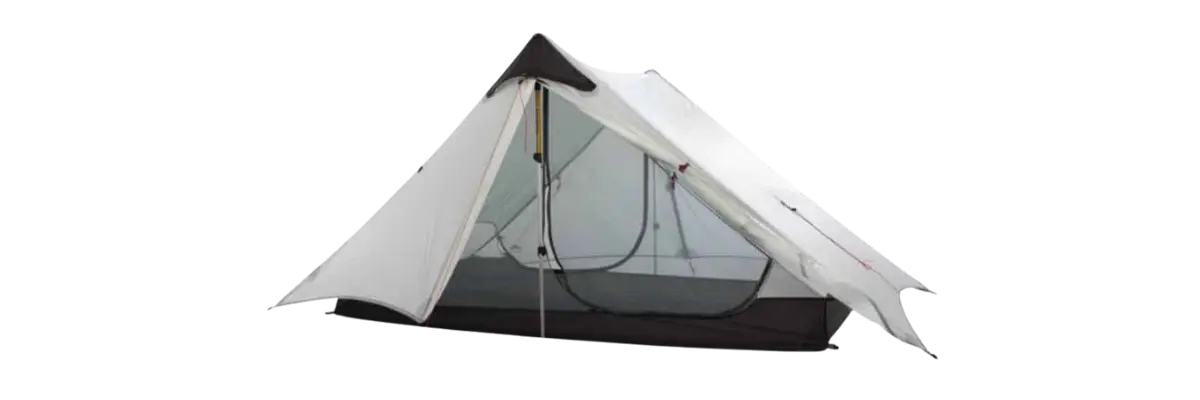
Specs at a Glance: Lanshan 2
| Spec | Detail |
|---|---|
| Price (USD) | $158 (3FUL Gear direct); commonly $140 to $180 across authorized resellers |
| Trail Weight | 1,060 g / 37.4 oz (fly and inner only) |
| Packed Weight | 1,220 g / 43 oz (includes stakes, guylines, stuff sack) |
| Capacity | 2-person |
| Floor Dimensions | 86.6 in x 43.3 in / 220 cm x 110 cm |
| Peak Height | Approximately 47 to 49 in / 120 to 125 cm (varies by source and trekking pole length used) |
| Packed Size | 13.4 in x 5.9 in / 34 cm x 15 cm |
| Shelter Type | Non-freestanding, trekking-pole supported, double-wall |
| Shelter Material | Fly: 15D silicone and PU-coated ripstop nylon. Inner: 20D nylon no-see-um mesh. Floor: 20D PU-coated nylon |
| Canopy Weight (oz/sqyd) | Not specified (manufacturer publishes denier, not fabric weight per square yard) |
| Floor Weight (oz/sqyd) | Not specified |
| Number of Doors | 2 |
| Number of Vestibules | 2 |
| Wall Construction | Double wall, separate mesh inner clipped beneath the fly |
| Season Rating | 3-season (a 4-season, more enclosed inner is sold as an alternative) |
| Trekking Poles Required | Yes, 2 adjustable poles, 120 to 125 cm recommended, sold separately |
| Warranty | Not specified. 3FUL Gear publishes a general warranty policy but no fixed term was confirmed for this model |
| Lead Time | Not specified precisely. Orders placed directly from the manufacturer’s site have historically taken about 2 to 3 weeks to arrive in North America and Europe |
3FULGEAR Lanshan 2 Tent Design and Build Quality
The Lanshan 2 is built around a simple idea: get a workable double-wall shelter to market for as little money as possible, and it mostly succeeds. The fly is 15-denier silicone and PU-coated ripstop nylon, the inner tent uses 20-denier no-see-um mesh, and the bathtub floor is a heavier 20-denier PU nylon designed to resist ground moisture and abrasion. None of these fabrics are exotic. You won’t find Dyneema or high-tenacity silpoly here, and that’s exactly why the price is what it is.
What justifies the cost is the assembly, not the materials. The tent ships seam-sealed from the factory, which is a genuine convenience since the Pro version in the same lineup requires you to pay extra or do it yourself. Zippers are YKK, which is a reassuring detail on a budget tent since cheap zippers are usually the first thing to fail. Guyout points are reinforced at the main structural corners, and the twin trekking-pole pockets sit behind small peak vents backed by insect netting.
Where the build quality shows its price is in the small stuff: the stock stakes are light aluminum with a simple notch cutout that isn’t the most secure in soft or sandy ground, and the guyline cordage feels thinner than what you’d get from a premium brand. None of this is a dealbreaker, but it explains why so many owners swap the stakes before their first real trip.
Setup and Pitch of the Lanshan 2
At 220 cm long and 110 cm wide (86.6 by 43.3 inches), the Lanshan 2’s floor is on the smaller side for a tent marketed as a two-person shelter. Two people can fit, but you should like each other. Realistically, this is a comfortable one-person-plus-gear tent or a cozy fit for two people who don’t mind sharing space and storing most of their gear in the vestibules.
Peak height sits somewhere between 120 and 125 cm depending on which spec sheet you read and how you pitch it, which works out to roughly 47 to 49 inches. That’s enough to sit up in the center of the tent but not enough for much more than that. Tall sleepers should pay close attention here: reviewers over 6 feet tall have reported their feet pressing into the far wall, which can lead to condensation transferring onto sleeping bags overnight. If you’re under 5’10”, this won’t be an issue. If you’re pushing 6’2″ or taller, budget for some contact with the far wall.
The two vestibules are a genuine strength, each deep enough to stash a full backpack and boots out of the weather, and the twin-door layout means neither occupant has to crawl over the other to get in or out. Interior pocket count and placement were not clearly documented by the manufacturer or independent reviewers, so treat that as an open question until you have the tent in hand.
Weather Performance of the 3FULGEAR Lanshan 2 Tent
This is a trekking-pole tent, so setup starts with staking out the footprint before your poles ever go up. 3FUL recommends adjustable poles set between 120 and 125 cm, and independent testing has found a minimum of six stakes needed to get a stable pitch, though most owners carry eight to ten stakes plus a few spares once they’ve used the tent a handful of times.
There is a real learning curve here, and more than one reviewer has flagged it independently. The trekking-pole retention loops hidden beneath the peak vents take some fiddling to get the tension right, and the vestibule guylines use a pre-measured knot that you should not untie, since it sets the correct stake placement and isn’t explained anywhere in the included instructions. First-time pitches tend to be messy. Second and third attempts go much faster once you’ve watched a setup video or two.
The PU-coated nylon fly is not a no-stretch fabric like silpoly or Dyneema, which means it can loosen and sag slightly overnight as humidity and temperature change, especially across the inner mesh ceiling. A mid-pitch re-tension, or simply setting the guylines a bit tighter than feels necessary at first, goes a long way toward keeping the fly taut through the night. On uneven ground, the non-freestanding design is forgiving as long as you can find two anchor points at roughly the right diagonal spacing.
3FULGEAR Lanshan 2 Tent Value and Comparisons
Waterproof ratings for the Lanshan 2 vary by source, with the fly reported anywhere from 4,000 mm to 5,000 mm hydrostatic head and the floor between 6,000 mm and 8,000 mm depending on which retailer’s spec sheet you check. Even at the lower end, those numbers are solid for sustained rain, and the double-wall design keeps the mesh inner from getting directly rained on, which is one of the clearest advantages this tent has over its own single-wall Pro sibling.
Ventilation comes from peak vents at the top of each vestibule, backed by insect mesh, plus the curved base of the fly, which the manufacturer says is engineered to promote airflow and reduce condensation buildup even in cooler temperatures. In practice, condensation is still a known issue, particularly for taller occupants whose sleeping bags contact the tent walls, and particularly in humid or still conditions where airflow through the vents alone isn’t enough. The double-wall construction helps keep condensation off your gear compared to a single-wall tent, since moisture that forms on the fly generally doesn’t transfer through to the mesh inner.
No independent wind-speed testing figures were found for this specific model. The dual-apex, trekking-pole geometry is a well-proven shape for shedding wind when properly staked and guyed, but this is not a shelter built for sustained high-wind exposure above treeline. Treat it as a solid three-season tent for forest, ridge, and valley camping rather than a storm-focused mountaineering shelter.
Lanshan 2 Value and Comparisons
The clearest comparison is the tent’s own sibling, the Lanshan 2 Pro. The Pro trades the double-wall design for a single-wall, connected inner and fly, dropping weight to somewhere around 930 to 970 g at the cost of needing seam sealing yourself (or paying $35 extra) and giving up the condensation buffer that a separate mesh inner provides. If you’re chasing every ounce and don’t mind more condensation management, the Pro is tempting for about $30 to $40 more. If you’d rather not deal with wet gear on damp mornings, the classic double-wall Lanshan 2 is the better choice.
Stepping up in price, the Durston X-Mid 2 runs around $289 and weighs close to 975 g to 1,005 g in its typical trekking-pole setup, with a larger 234 by 132 cm floor and a taller 122 cm peak height. It uses a no-stretch silpoly fabric that holds its pitch better overnight than the Lanshan’s PU nylon, and it’s widely regarded as one of the best-designed trekking-pole tents on the market. For hikers who can stretch their budget by about $130, the X-Mid 2 offers a meaningfully more livable and better-engineered shelter.
The Six Moon Designs Lunar Duo Explorer sits at the other end, around $395 and 1,270 to 1,276 g, single-wall, with a wider 137 cm floor and a taller 114 cm peak height, but only one door. It’s roomier and more of a basecamp-style palace, but it costs more than double the Lanshan 2 and carries more condensation risk as a single-wall design.
Buyers who should choose the Lanshan 2 over these alternatives are first-time ultralight backpackers testing the trekking-pole-tent format, thru-hikers on a tight gear budget who still want a double-wall shelter, and weekend backpackers under about 6 feet tall who mostly camp in mild three-season conditions. If your budget can flex upward, or you’re taller than average, the Durston or the Lunar Duo will serve you better long-term.
Lanshan 2 by 3FULGEAR FAQ
Is the Lanshan 2 good in the rain? Yes, for most three-season conditions. The fly and floor carry a solid waterproof rating and the tent ships seam-sealed, so as long as it’s pitched taut, sustained rain shouldn’t be an issue.
How windy can it get before the Lanshan 2 struggles? No official wind rating exists for this tent. The dual-apex trekking-pole shape sheds moderate wind well when properly staked, but it isn’t designed for sustained exposure above treeline or in severe storms.
Is the Lanshan 2 hard to set up? There’s a real learning curve for your first pitch or two, mostly around trekking-pole tensioning and stake placement. Most people find it becomes quick and intuitive after a couple of practice runs at home.
Is the Lanshan 2 a 4-season tent? Not in its standard configuration. It’s rated for 3-season use, though 3FUL sells an alternative inner with more solid fabric for colder conditions.
Will the Lanshan 2 fit two people comfortably? It fits two people, but comfortably is doing some work in that sentence. It’s better suited to one person with gear, or two people who are fine sharing tight quarters and storing most gear in the vestibules.
Does condensation build up inside the Lanshan 2? Some, especially in humid or still air, but less than a single-wall tent thanks to the separate mesh inner. Taller sleepers whose bags touch the tent wall are most likely to notice it.
Do I need a footprint or groundsheet? It’s not strictly required since the floor is a coated bathtub design, but a footprint is cheap insurance against punctures and is commonly sold as an accessory by the manufacturer.