

The Gossamer Gear Whisper costs $499. The Zpacks Altaplex costs $699. That’s roughly a $200 gap between two single-wall, trekking pole, DCF shelters that look, on paper, like they’re solving the same problem. If you assume that gap is about weight, you’ll pick the wrong shelter. The Whisper weighs 9.8 oz and the Altaplex weighs 13.2 oz in its Lite build, so the “lighter” tent is actually the cheaper one. The real $200 is buying you something else entirely: a fundamentally different relationship between your body, your ground, and your gear. Understanding that difference is what actually tells you which one belongs in your pack.
Whisper vs Altaplex: The Spec Snapshot
Before getting into the “why,” here’s the “what.” Both are single-wall DCF shelters that pitch with trekking poles, but the numbers diverge fast once you look past price.
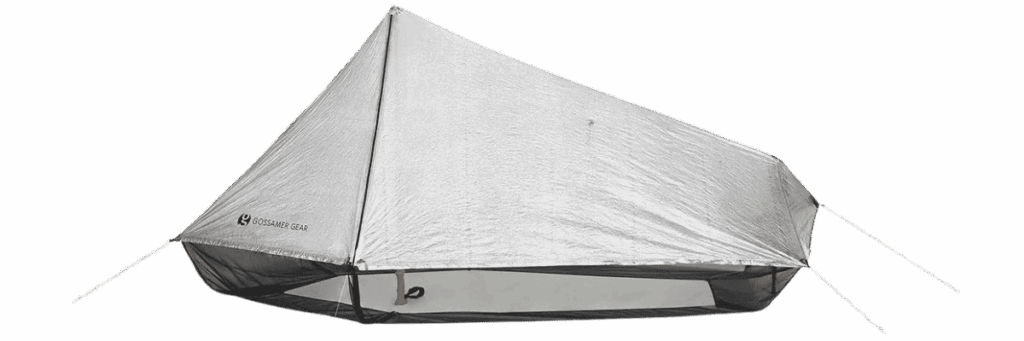
- Gossamer Gear Whisper: $499, 9.8 oz, floorless, two trekking poles (130 cm front, 23 in rear), 102 in floor length, 130.5 cm peak height. Full Whisper specs and review here.
- Zpacks Altaplex: $699, 13.2 oz (Lite), sewn-in bathtub floor, one trekking pole (56 to 58 in), 90 in floor length, 56 to 58 in peak height. Full Altaplex specs and review here.

Notice what doesn’t line up. The Whisper is lighter and cheaper, but the Altaplex is the one built for genuinely tall hikers (up to 6’6″), while the Whisper tops out comfortably around 6’2″. The Whisper’s floor is actually longer at 102 inches, but that length is spent on floorless livable volume, not sit-up headroom. This is the pattern you’ll see all the way through this guide: the two shelters trade advantages rather than one simply beating the other.
Floorless vs Bathtub Floor: Where the Money Actually Goes
This is the single biggest difference between these two shelters, and it’s the one that new ultralight hikers underestimate the most. The Whisper is floorless. There is no built-in bathtub floor, no sewn-in bug netting connected to a groundsheet, nothing between you and the dirt except whatever ground cloth you bring yourself. The Altaplex has a full sewn-in bathtub floor made from 0.75 to 1.0 oz/sqyd DCF, recessed and raised off the ground, functioning exactly like a traditional tent.
That single design choice changes your entire camp routine. With the Whisper, you’re pitching a shelter and then separately laying out a $13 to $17 polycryo groundsheet, which adds 1.5 to 3 oz back to your total system weight. Wind can occasionally push spray under the mesh skirt in driving rain, so site selection matters more than it does with a fully enclosed floor. With the Altaplex, you unroll the tent and you’re done. The floor comes with you.
This is also where beginners tend to get surprised after the purchase, not before it. A floorless shelter is a workflow, not just a tent. You’re managing a separate piece of gear every single night, checking it for punctures, and accepting that a determined line of ants or a puddle from unexpected rain has a more direct path to your sleeping bag.
Before you decide, ask yourself: do you actually want one less thing to manage at camp after a 20 mile day, or are you comfortable adding a step to your routine in exchange for a lighter, cheaper shelter?
Height and Space: Who Actually Fits Inside Each One
The Altaplex exists because of one specific problem: tall hikers get squeezed out of ultralight shelters. At 90 inches long with a 56 to 58 inch peak, it comfortably fits hikers up to 6’6″, which is genuinely rare territory for anything under a pound. The tradeoff is width. The single center pole creates steep wall angles, so that peak height narrows fast as you move away from the ridge, and the 40 inch floor width feels tighter than the number suggests once you add a sleeping pad and your shoulders.
The Whisper takes the opposite approach. Its two-pole offset geometry (a 130.5 cm pole at the head, a short 59 cm pole at the foot) spreads the volume across the full 102 inch floor length instead of concentrating it at one peak. Hikers up to about 6’2″ can sleep without their bag touching the canopy at either end, and there’s genuine sit-up room near the front pole for changing clothes or waiting out weather. Toward the foot end, though, the canopy drops fast, so sprawled sleepers will feel the taper.
Neither shelter fits two people. Both are strictly solo shelters, and that’s worth stating plainly before you get further into this comparison.
Are you over 6’2″? That alone may settle this comparison before you read another word. Under 6’2″ and prioritizing floor space to move around in? The math tilts the other way.
One Pole or Two: The Pitch Learning Curve
This is where gear you already own matters as much as the shelter itself. The Altaplex needs a single trekking pole that extends to 56 to 58 inches, which is longer than most stock trekking poles reach. If your poles top out around 53 inches, you’ll need a trekking pole jack or a dedicated tent pole, adding $15 to $45 to the real cost of ownership. Check your trekking pole specs against shelter pole height requirements before you buy either of these tents, because this is the most common post-purchase surprise in the ultralight community.
The Whisper’s two-pole setup is more forgiving on pole length (one pole to 130 cm, a second collapsed to roughly 23 inches, or even a smooth 60 cm stick in a pinch) but it asks for more precision during the pitch itself. You need 7 stakes, and three of them carry real structural load, so lightweight stakes won’t cut it at every point. Once you get the sequence down it’s a 10 minute job, but the first couple of attempts will feel fiddly compared to a simpler single-pole pyramid.
Both shelters share one unforgiving trait: DCF does not stretch. A silnylon tent sags overnight and you retension it half-asleep at 2 a.m. A DCF shelter holds whatever pitch you gave it, for better and worse. Pitch it wrong by a few inches and you can’t tension your way out of it, you have to reset the stakes. That’s true of the Whisper and the Altaplex equally, and it’s a real adjustment if you’re coming from a freestanding pole tent.
Do you already own trekking poles long enough for the Altaplex, or would you need to buy an extension just to make it work? That single logistics question can add real dollars to whichever shelter looks cheaper on the spec sheet.
Weather, Wind, and Condensation: How They Actually Perform
Both shelters handle wind well when staked correctly, and both are honest 3-season shelters, not 4-season mountaineering tents. The Whisper has been tested through gusts near 30 mph, overnight lows to 18°F, and light snow loading, holding its shape when the rear (low-profile) end is pitched into the wind. The Altaplex has reported similarly solid performance on exposed routes like the Colorado Trail, provided you use the full 10-stake storm configuration rather than the minimum 6.
Condensation is the honest weakness of every single-wall shelter, and neither of these escapes it. The Whisper’s full perimeter mesh skirt gives it continuous ventilation, which genuinely helps in moving air. The Altaplex relies on overlapping storm doors and a mesh floor perimeter, but has no dedicated peak vents, so in calm, humid conditions you’ll wake up to interior moisture on both shelters. Neither is going to eliminate this problem. You’re managing it, not solving it, on any single-wall DCF shelter. If durability and long-term wear factor into your decision, it’s worth reading up on how ultralight shelters actually hold up over repeated seasons before committing $500 to $700 to either option.
The Part of the $200 Nobody Mentions: Warranty and Field Repairs
Here’s a piece of the price gap that rarely comes up in gear reviews. The Altaplex ships with a 2-year limited warranty, two spare zipper sliders, and a 54 inch DCF repair strip included in the box. Its storm doors close with metal hooks instead of zippers, which removes the single most common failure point on any single-wall shelter before it ever becomes a problem on trail. That’s not a marketing footnote, that’s Zpacks pricing in over a decade of iteration on exactly where this style of shelter tends to fail in the field.
The Whisper carries Gossamer Gear’s standard warranty against defects, which is solid, but it doesn’t come with the same built-in spare parts kit, and its door zipper is a known long-term wear point specifically because a floorless design means that zipper drags through dirt every single time you enter or exit. It’s a smaller, younger product line (the Whisper is a production version of a hiker’s personal prototype) rather than the tenth generation of a proven geometry.
None of this means the Whisper is poorly made. It means that some of that extra $200 for the Altaplex is quietly paying for fewer surprises three hundred miles into a thru-hike, not just a taller peak. If you’re the type of hiker who wants to carry a small repair kit and troubleshoot in the field yourself, this matters less. If you’d rather the manufacturer had already solved that problem before it shipped, it matters more than the spec sheet lets on.
Matching the Shelter to Your Trip: Thru-Hiking, Weekend Trips, and Bikepacking
The right answer here genuinely changes based on what you’re actually doing with the shelter, which is the part most comparisons skip.
Thru-hiking: if you’re chasing a sub-1 lb shelter system on a dry-leaning trail (PCT desert sections, CDT, Colorado Trail), the Whisper’s weight and price make it the more common choice among long-distance hikers who’ve already accepted floorless camping as part of the tradeoff. If you’re 6’2″ or taller and know you’ll be spending consecutive rainy days sitting up inside your tent, the Altaplex’s fully enclosed floor and taller peak earn back some of that extra $200 in comfort over a five month hike.
Weekend and section backpacking: this is where the floorless workflow of the Whisper matters less, because you’re not doing it 100+ nights in a row. If you’re newer to trekking pole shelters generally, the Altaplex’s sewn-in floor removes one more variable to think about while you’re still learning to pitch a non-freestanding tent, even though its single-pole pitch has its own learning curve.
Bikepacking: packed volume tends to matter as much as weight when you’re stuffing a shelter into a frame bag or seat pack. The Altaplex Lite rolls down to roughly 2.9 liters (4.5 in diameter by 11 in), while the Whisper packs to a 5 by 13 inch bundle. Also worth checking before you buy for a bike trip: does your bike-specific trekking pole (or lack of one) actually reach the Altaplex’s required 56 to 58 inches? Many riders carry shorter or folding poles that won’t extend that far, which can quietly rule out the Altaplex regardless of price. If you’re bikepacking and don’t need the extra height the Altaplex was built for, the shorter, more flexible pole requirements of the Whisper (or its close sibling, discussed in this Whisper vs Zpacks Plex Solo comparison) tend to be the easier fit.
If height isn’t actually your constraint and you just want Zpacks’ single-pole design at a lower price and weight than the Altaplex, it’s also worth reading how the Plex Solo compares directly to the Altaplex before you spend the extra $100.
What does a typical night in your shelter actually look like? Are you crawling in exhausted and asleep in minutes, or sitting up for an hour eating dinner and waiting out weather? Your honest answer probably points more clearly to one shelter than any spec sheet does.
So Which One Should You Buy?
Strip away the marketing and the decision comes down to three honest questions.
- Are you taller than 6’2″? Choose the Altaplex. This is the single strongest deciding factor in this entire comparison, and no amount of price savings on the Whisper fixes a shelter that’s too short for you.
- Do you already own trekking poles long enough for the Altaplex (56 to 58 in), or are you willing to buy an extension? If not, the Whisper’s shorter pole requirements remove a hidden cost and hassle.
- Are you comfortable managing a separate groundsheet every night, or do you want a floor built in? This is the real $200 question. The Whisper asks more of your routine in exchange for less weight and a lower price. The Altaplex asks more of your wallet in exchange for a simpler, more traditional tent experience.
If you’re new to ultralight shelters altogether, there’s no shame in leaning toward the Altaplex’s sewn-in floor while you build confidence with trekking pole pitches, then moving to a floorless setup like the Whisper once the routine feels automatic. If you’ve already got a season or two of trekking pole tents behind you and you’re chasing the lightest livable system for a long trail, the Whisper is very likely your answer. Either way, the $200 gap between these two shelters was never really about the number on the scale. It was about how much of your nightly routine you’re willing to hand over to a groundsheet.



