

You spent months researching your shelter. You read the fabric comparisons, you agonized over one person versus two, you finally clicked buy. Then it arrived with a small nylon bag of thin, unbranded metal pins, and you assumed those were part of the deal.
They are not. Included stakes are the cheapest component in the box, and on a non-freestanding shelter they are the single thing standing between you and a collapsed tent at 2 a.m.
This matters more than most beginners expect, because holding power varies wildly. In stake testing published by Backpacking Light, an MSR Groundhog held roughly 64 pounds in moist sod, while a titanium shepherd’s hook stake in the same test held about 31 pounds. Same ground, same method, double the security. That gap is what you are actually buying.
Below are nine stakes ranked best to worst for ultralight backpacking, bikepacking, and hiking. Every one of them is a real upgrade over what came in your box. The ranking tells you which is the safest default, and the notes tell you when a lower-ranked stake is actually the smarter buy for you.
The Quick Stake Comparison
Prices and weights are manufacturer figures checked in September 2026 and will drift over time.
| Stake | Weight each | Length | Sold as | Price per stake | Best for |
|---|---|---|---|---|---|
| MSR Groundhog | 13.95 g / 0.49 oz | 7.5 in | 6-pack, $38.95 | $6.49 | Best overall, storms, mixed soil |
| NEMO Sweepstake | 20 g / 0.7 oz | 7 in | 6-pack, $24.95 | $4.16 | Mud, rain, night visibility |
| NEMO Airpin | 10 g / 0.35 oz | 6 in | 2 or 4 pack, from $9.95 | $4.98 | Guylines without knots or tensioners |
| Zpacks 6″ Sonic | 8.5 g / 0.3 oz | 6 in | Single | $2.75 | Best value, first full set |
| Vargo Titanium Ultralight | 7 g / 0.25 oz | 6 in | Single | $3.25 | Rocky, rooty, compacted ground |
| Zpacks Carbon Fiber Nail | 6.2 g / 0.22 oz | 6.4 in | Single | $4.95 | Loose soil, air travel, lowest weight |
| Zpacks Titanium Hook | 8 g / 0.28 oz | 6.5 in | Single | $2.95 | Cheapest per stake, guylines |
| DutchWare Aluminum Spiral | 37 g / 1.3 oz | 9.75 in | Single | $2.81 | Sand, snow, soft soil, big tarps |
| MSR Mini Groundhog | 9.4 g / 0.33 oz | 6 in | 6-pack, $34.95 | $5.83 | Light Y-beam, firm ground only |
What Actually Separates a Good Stake From a Bad One
Four things decide this, and only four. Everything else is marketing.
Shape beats material. A Y-beam or spiral shape displaces far more soil than a round pin, so it resists being pulled sideways out of the ground. This is why an aluminum Y-beam routinely outperforms a titanium hook that weighs less. Titanium is stronger per gram, but a thin round shaft simply has less dirt gripping it.
Length is holding power. Longer stakes reach deeper, denser soil. A 9.75 inch spiral will hold in beach sand where a 6 inch pin will not. The trade is that long stakes are harder to drive into hard-packed dirt.
Your shelter type sets the stakes count. A freestanding tent like the NEMO Hornet OSMO 1P stands up on its own and uses stakes mainly to pull out the vestibule, so four to six is fine. A trekking pole shelter is the opposite. It has no structure at all without stakes. A Zpacks Duplex Classic wants eight to be pitched properly, and a pyramid like the HMG UltaMid 2 asks for eight around the perimeter before you add any guylines.
Cost per stake is the number to compare, not the pack price. A $38.95 six-pack sounds expensive next to a $2.75 single until you realize you need eight of them.
1. MSR Groundhog: Best Overall Ultralight Tent Stake
- Weight: 13.95 g (0.49 oz) each
- Length: 7.5 in / 19 cm
- Material: 7000-series aluminum, Y-beam
- Price: $38.95 for 6 ($6.49 each)
- Set of 8 weighs: 112 g / 3.9 oz
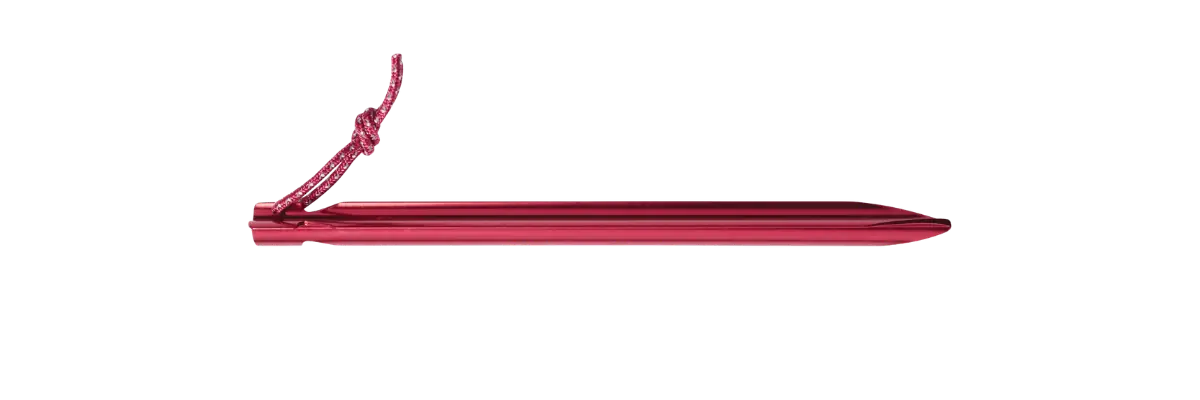
If you want to stop thinking about stakes forever, buy these and move on. The Groundhog is the most tested stake in backpacking, and it wins on the one metric that matters when weather turns: it held roughly double the pulling force of a shepherd’s hook stake in independent testing, in both wet and compacted ground.
The Y-beam cross section is why. Three fins of aluminum grip soil that a round pin slides through. At 7.5 inches it is also the longest of the non-specialty stakes here, and the reflective pull loop genuinely helps you find them at dusk instead of leaving one behind.
The downsides are honest ones. It is the heaviest of the mainstream picks at 13.95 g, and at $6.49 per stake a set of eight is a real spend. It also stocks out regularly, so check availability before you plan around it.
Buy it if you camp in variable conditions, use a non-freestanding shelter, or you have ever had a stake pull in the night and do not want a repeat.
Check the current price on the MSR Groundhog
2. NEMO Sweepstake: Runner Up and Best for Mud and Night Visibility
- Weight: 20 g (0.7 oz) each
- Length: 7 in / 18 cm
- Material: 7000-series aluminum, Y-beam, with polymer biscuit
- Price: $24.95 for 6 ($4.16 each)
- Set of 8 weighs: 160 g / 5.6 oz
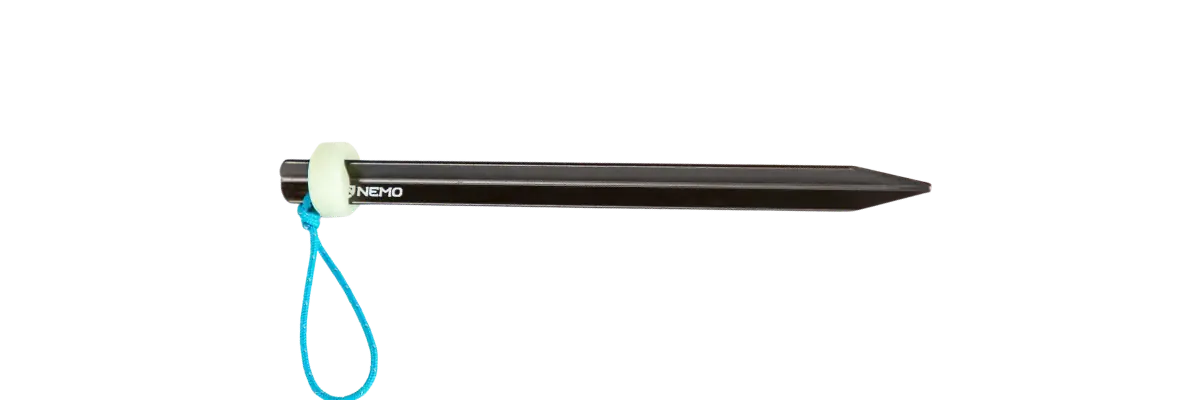
Same Y-beam logic as the Groundhog, at a meaningfully lower price per stake, with one clever addition. A tethered polymer ring rides on the shaft, and sliding it down scrapes off mud as you pull the stake. That sounds like a gimmick until you have packed a wet campsite in the rain and shoved eight dirt-caked pins into the same bag as your quilt.
The biscuit also glows in the dark, which quietly solves the two most common beginner stake problems: tripping over a guyline at night, and leaving a stake behind at breakout.
The cost is weight. At 20 g each these are the heaviest per-stake option outside of the sand specialist, and a set of eight is 5.6 oz. That is a real penalty on an ultralight kit.
Buy it if you hike in wet regions, camp in shoulder season mud, or you are on a budget and still want proper Y-beam holding power.
Check the current price on the NEMO Sweepstake
3. NEMO Airpin: Best for Guylines Without Knots or Tensioners
- Weight: 10 g (0.35 oz) each
- Length: 6 in / 15 cm total, roughly 4.5 in effective
- Material: 7075 aluminum, tapered nail profile
- Price: $9.95 for 2 ($4.98 each)
- Set of 8 weighs: 80 g / 2.8 oz
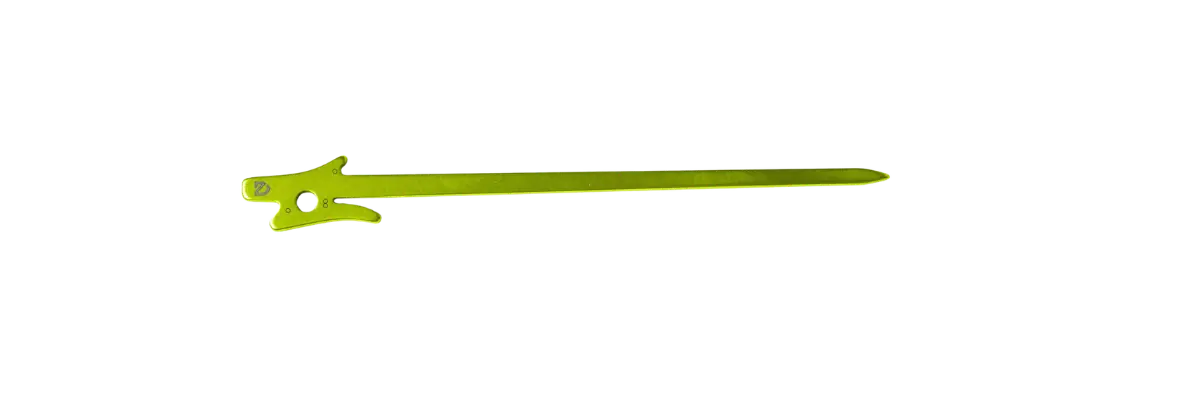
The Airpin does something no other stake here does. Three notches in the head let you wrap a guyline directly into the stake and lock it under tension, so you can delete your cord locks and your knots entirely. For a beginner still fumbling with a taut-line hitch in the dark, that is a genuine relief.
They drive easily too. Testers found the tapered 7075 shaft went into rocky ground more readily than a Groundhog did.
Two things keep it at third. Holding power measured 36 pounds in moist sod, closer to a shepherd’s hook than a Y-beam, partly because you must leave over an inch of stake above ground for the notches. And re-tensioning means fully unwrapping the cord, which is the last thing you want to do at midnight when your silnylon has stretched and sagged.
Buy it if you want the simplest possible guyline system and camp mostly in fair weather. Use Y-beams at your load-bearing corners.
Check the current price on the NEMO Airpin
4. Zpacks 6″ Sonic Stake: Best Value and Best First Full Set
- Weight: 8.5 g (0.3 oz) each, including cord
- Length: 6 in / 15.2 cm, 8 mm diameter
- Material: High grade aluminum, Y-beam
- Price: $2.75 each
- Set of 8 weighs: 68 g / 2.4 oz
This is the sweet spot for most people reading this guide. You get the Y-beam shape that drives the holding power numbers, at 60 percent less weight than a Groundhog and less than half the price per stake. Eight of them cost $22 and weigh 2.4 oz.
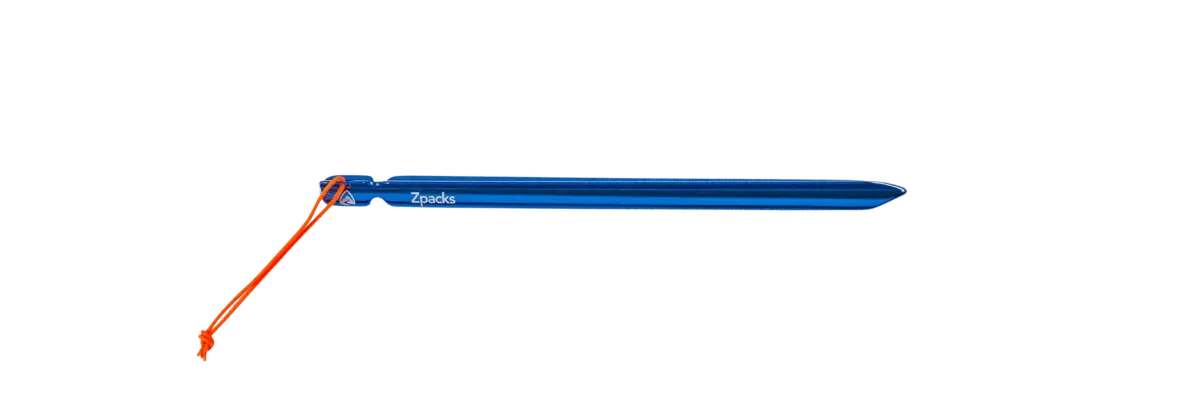
They are bright blue with a pull cord, which is a real feature and not decoration. Dropped stakes are the most common gear loss in backpacking. Zpacks rates them good for bend resistance and better for holding power, which is an honest self-assessment rather than a boast.
The catch is that thinner aluminum in a shorter stake means you cannot abuse them. Zpacks says outright never to hammer them, and that if you put your full body weight on one it can bend, though it will usually bend back.
Buy it if you want the best balance of price, weight, and grip, and you are willing to press stakes in rather than pound them.
Check the current price on the Zpacks Sonic Stake
5. Vargo Titanium Ultralight: Best for Rocky and Root-Bound Ground
- Weight: 7 g (0.25 oz) each
- Length: 6 in / 152 mm, 3 mm diameter
- Material: Titanium, shepherd’s hook
- Price: $3.25 each
- Set of 8 weighs: 56 g / 2.0 oz
At 3 mm thick this is essentially a titanium wire with a hook, and that thinness is the entire point. Where a fat Y-beam stops dead against a root or a buried stone, a 3 mm shaft slips into the gap beside it. Vargo’s own reviewers keep repeating the same thing: small diameter, goes into rocky soil easily, hard to bend.
Titanium also has shape memory that aluminum lacks. Bend one and it tends to spring back rather than staying crooked.
The reason it sits at fifth is pure physics. A thin round pin displaces very little soil, and shepherd’s hook stakes measured around 31 pounds of holding power in the same testing where a Groundhog hit 64. In soft or saturated ground these pull out. They are also frequently out of stock at Vargo.
Buy it if you hike granite country, dry compacted trails, or forest floors full of roots. Do not make these your only stakes.
Check the current price on the Vargo Titanium Ultralight
6. Zpacks Carbon Fiber Nail Stake: Lightest Stake With Real Holding Power
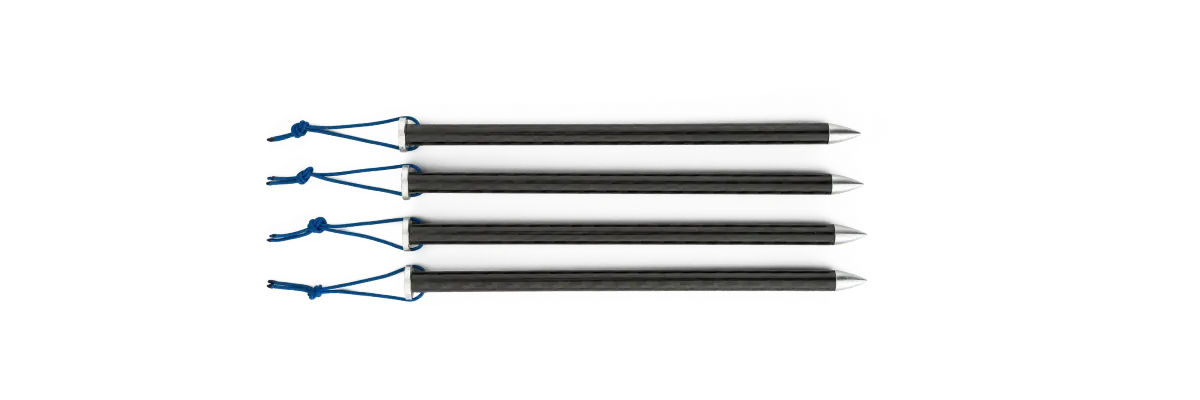
- Weight: 6.2 g (0.22 oz) each
- Length: 6.4 in / 16 cm, 7.5 mm diameter
- Material: Carbon fiber shaft with metal tip and end cap
- Price: $4.95 each
- Set of 8 weighs: 50 g / 1.75 oz
The lightest stake in this guide is also, per gram, the grippiest. Zpacks rates it as the best holding power to weight ratio in their entire lineup, because the 7.5 mm carbon shaft is more than twice the diameter of a titanium hook while weighing less. Thick shaft, loose soil, no bending. It cannot bend at all, in fact.
There is one benefit nobody advertises and it is worth real money to some readers. These are non-metallic, and Zpacks reports carrying them through US airport security repeatedly without issue, while metal stakes get confiscated roughly half the time. If you fly to trailheads, this is the stake.
The trade-offs are specific. Carbon does not bend, so under enough stress it snaps instead, and the bonded metal tips can occasionally come unglued. Zpacks suggests carrying a tiny tube of superglue. The thick diameter is also harder to press into compacted ground.
Buy it if you camp in soft soil, count grams seriously, or fly to your hikes.
Check the current price on the Zpacks Carbon Fiber Stake
7. Zpacks 6.5″ Titanium Hook Stake: Best Budget Pick
- Weight: 8 g (0.28 oz) each
- Length: 6.5 in / 16.5 cm, 3.5 mm diameter
- Material: Titanium, shepherd’s hook, red head
- Price: $2.95 each
- Set of 8 weighs: 64 g / 2.3 oz
This is the beefed-up shepherd’s hook. Longer and thicker than a standard 6 inch titanium pin, which buys you more grip and better bend resistance, while still slipping into packed or frozen ground that a wide stake would bounce off. The red head is there so you can find them, and it works.
At $2.95 it is nearly the cheapest option here, and a full set of eight comes to $23.60 and 2.3 oz, which is a serious upgrade over included stakes for the price of a burrito.
It still carries the shepherd’s hook limitation. Round profile, modest holding power, and the hook can roll and release a guyline if the loop is not seated. Zpacks rates it good for holding rather than better, and recommends anchoring with rocks in high wind.
Buy it if you need eight stakes cheap, hike firm ground, or want inexpensive extras for secondary guylines.
Check the current price on the Zpacks Titanium Hook Stake
8. DutchWare Aluminum Spiral (Cyclone) Stake: Best for Sand, Snow, and Soft Ground

- Weight: 37 g (1.3 oz) each
- Length: 9.75 in
- Material: Aluminum, spiral profile, reflective pull loop
- Price: $2.81 each
- Set of 8 weighs: 296 g / 10.4 oz
This is not a competitor to the others, it is the specialist you bring when the others will fail. Nearly ten inches long with a corkscrew profile, it drives deep and grips soil that offers no resistance to a short pin. DutchWare positions it for soft ground and large tarps and wings, which is exactly right.
It ranks eighth for one reason: at 37 g it weighs nearly three times a Groundhog and over five times a carbon nail. A full set is 10.4 oz, which is more than some ultralight shelters weigh on their own. Nobody should carry eight of these on a normal trip.
Buy it if you camp on beaches, dunes, snow, marshy meadows, or you pitch a large tarp with high wind loads. Carry two, not eight, and use them at your most loaded corners.
Check the current price on the DutchWare Aluminum Spiral Stake
9. MSR Mini Groundhog: Lightest Y-Beam, With a Catch
- Weight: 9.4 g (0.33 oz) each
- Length: 6 in / 15 cm
- Material: 7000-series aluminum, Y-beam
- Price: $34.95 for 6 ($5.83 each)
- Set of 8 weighs: 75 g / 2.7 oz
Let us be clear: this is a very good stake, and it finishes last on value rather than on quality. It is a shrunken Groundhog, keeping the Y-beam and the 7000-series aluminum while shedding roughly a third of the weight. MSR is upfront that it holds in medium to firm soil, which is the tell.
The problem is the math. At $5.83 per stake it is the second most expensive option in this guide, yet the Zpacks Sonic gives you the same Y-beam shape, a gram less weight, and the same 6 inch length for $2.75. You are paying roughly double for the MSR badge and a slightly tougher alloy.
Losing 1.5 inches versus the full Groundhog also costs you exactly where you need it most, in the soft wet ground where holding power collapses. And like its bigger sibling, it stocks out often.
Buy it if you already trust MSR, hike firm ground, and want a Y-beam at a lower weight than the full Groundhog. Otherwise the Sonic does the same job for less.
Check the current price on the MSR Mini Groundhog
So Which One Should You Actually Buy?
Find yourself in one of these five and stop reading.
- You want one answer and no regrets: MSR Groundhog. Heaviest of the mainstream picks, and the only one with a proven 60-plus pound holding number.
- You are buying your first real set on a budget: eight Zpacks Sonic Stakes. $22, 2.4 oz, Y-beam grip.
- You count every gram or fly to trailheads: Zpacks Carbon Fiber Nail Stakes.
- You hike wet, muddy, or rainy country: NEMO Sweepstake. Accept the 5.6 oz.
- You hike rock and roots: Vargo Titanium Ultralight, with two Y-beams for the main corners.
The Move Experienced Hikers Make: Mix Your Set
No single stake is best everywhere, and you do not have to pick one. Experienced hikers carry a deliberate mix, because the loads on a shelter are not evenly distributed. The two main corners of a trekking pole shelter take most of the tension. The secondary guylines take very little.
A proven eight stake kit for a shelter like the Durston X-Mid Pro 2, which pitches its main structure off four corner stakes, looks like this:
- 4 Y-beam stakes (Groundhog or Sonic) for the load-bearing corners
- 4 lighter hook or nail stakes (Vargo Titanium or Zpacks Carbon) for guylines and vestibules
- Optional: swap in 2 spiral stakes if you know you are camping on sand or snow
That kit weighs about 2.2 oz and costs around $27, and it handles more ground types than any single stake set you could buy.
Frequently Asked Questions
How many tent stakes do I actually need?
Count the stake points on your shelter, then add two. Most one and two person trekking pole shelters need six to eight. Freestanding tents need four to six. Pyramids need eight or more. The two spares cover the one you bend and the one you leave in the dirt, and everyone eventually does both.
Is titanium better than aluminum for tent stakes?
Not automatically. Titanium is stronger per gram and holds its shape better, but almost all titanium stakes are thin round pins, and shape matters more than material for holding power. An aluminum Y-beam typically outholds a titanium hook by a wide margin. Choose titanium for hard, rocky ground and aluminum Y-beams for grip.
Can I just use the stakes that came with my tent?
For a night in a campground, yes. For a non-freestanding shelter in weather, no. Included stakes are usually thin round aluminum pins chosen to hit a price point, and they bend on the first rocky pitch. If you invested in a good shelter, spending $25 to protect it is the highest value upgrade in your kit.
Should I hammer stakes in with a rock?
No. Every ultralight manufacturer here says the same thing: never hammer ultralight stakes. Place your foot on the stake, hold your ankle with both hands for stability, and press it in with your body weight. Hammering bends aluminum and snaps carbon fiber.
What do I do when the ground is too hard to drive a stake?
Wedge just the tip of the stake into the ground, lay the shaft flat, and pile rocks on top of it. This is called deadmanning and it works better than a half-driven stake. On bedrock, wrap guylines around rocks directly. On wooden platforms, wedge stakes between the boards or tie off to the platform edges.
Do I need different stakes for a Dyneema tent versus a silnylon tent?
Not different stakes, but be aware of a difference in behavior. Silnylon stretches when wet, so you will re-tension guylines overnight, which means stakes with a fixed cord lock like the Airpin get annoying. Dyneema does not stretch, so it transmits gust loads straight to the stake instead of absorbing them. Our Dyneema vs silnylon comparison covers the full trade-off.
How do I stop losing stakes?
Buy bright ones. Blue, red, reflective loops, and glow-in-the-dark heads all exist for this reason. Then count them out loud into a dedicated stake bag before you shoulder your pack. Do not put stakes loose in a pocket with your ultralight shelter fabric, because sharp tips and thin fabric is a puncture waiting to happen.
Are carbon fiber stakes worth the money?
For most beginners, no. For two specific hikers, absolutely: gram counters chasing the lightest possible kit, and anyone who flies to trailheads and is tired of losing metal stakes at security. Everyone else gets more real-world security from a cheaper aluminum Y-beam.
No One Stake Is Perfect For Each Trip
If you do nothing else, buy eight Zpacks Sonic Stakes for $22. It is the cheapest way to get proper Y-beam holding power, it saves weight over what came in your box, and it will not let you down on ordinary ground.
If your shelter is expensive, if it is non-freestanding, or if you camp anywhere the wind gets serious, spend the extra and get MSR Groundhogs. Double the holding power is not a marketing claim here, it is a measured number, and it is the difference between sleeping through a storm and repitching in the rain at 2 a.m.
Either way, the pins that came in the bag can stay home.



