

Hornet Osmo 2P Quick Take
The Nemo Hornet OSMO 2P is built for weight-conscious backpackers, thru-hikers, and fastpackers who want a familiar pole-supported tent that still ducks under the 2.5-pound mark. Its standout strength is the space-to-weight ratio: you get two doors, two vestibules, a hubbed pole that pitches in minutes, and Nemo’s sag-resistant OSMO fabric, all for a packed weight of 2 pounds 8 ounces. The main tradeoff is honest and unavoidable, which is that “2-person” here really means one person with room to spread out, or two people who genuinely like each other and pack small. If you want a roomy couples tent, this is not it, and that is by design.
Pros
- Exceptional space-to-weight ratio for a double-wall, two-door tent
- OSMO fabric resists sag when wet and stays taut through long storms
- Fast, intuitive, beginner-friendly setup with a single hubbed DAC pole
- Packs unusually small thanks to the short pole segments and Divvy Cube sack
Cons
- Tight for two adults, with a floor that tapers hard at the foot
- Thin 15-denier canopy and OSMO fly and floor demand careful site selection
- Semi-freestanding, so it needs staking to reach full volume and stability
- Middling wind performance and a truncated fly that can drip when you enter
Bottom line: At $479.95, a 2-pound-8-ounce packed weight, and a true 2-person rating, the Hornet OSMO 2P is one of the best space-to-weight values in an accessible, freestanding-style ultralight tent, as long as you treat it as a luxurious solo shelter or a cozy two-person one.



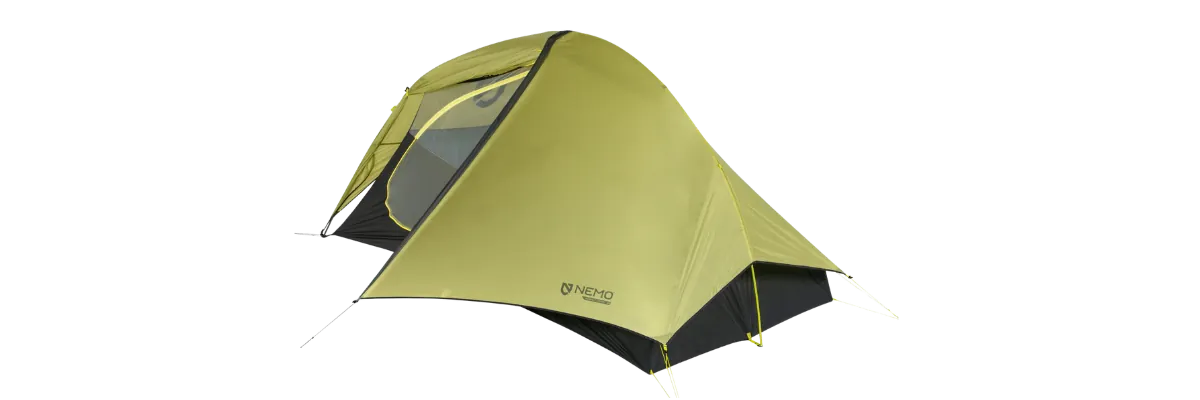
Specs at a Glance: Hornet Osmo 2P
| Spec | Detail |
|---|---|
| Price (USD) | $479.95 |
| Trail Weight | 948 g / 2 lb 1 oz (Nemo lists this as “minimum weight”) |
| Packed Weight | 1,140 g / 2 lb 8 oz |
| Capacity | 2-person |
| Floor Dimensions | 85 x 51/43 in / 215 x 130/108 cm (tapers from head to foot) |
| Floor Area | 27.5 sq ft / 2.6 sq m |
| Peak Height | 39 in / 98 cm |
| Packed Size | 12.5 x 7.5 x 3.5 in / 32 x 19 x 8.5 cm |
| Shelter Type | Semi-freestanding, double-wall |
| Shelter Material | OSMO poly-nylon ripstop fly (1,200 mm) and floor (1,500 mm); 15D nylon ripstop and no-see-um mesh canopy |
| Canopy Weight (oz/sqyd) | Not specified |
| Floor Weight (oz/sqyd) | Not specified |
| Number of Doors | 2 |
| Number of Vestibules | 2 (7.1 sq ft each) |
| Wall Construction | Double-wall |
| Season Rating | 3-season |
| Trekking Poles Required | No (dedicated DAC Featherlite NSL poles included) |
| Warranty | NEMO Lifetime Warranty |
| Lead Time | Not specified (in stock at Nemo and REI at time of writing) |
Nemo Hornet Osmo 2P Tent Design and Build Quality
The Hornet OSMO’s whole identity comes down to its fabric. OSMO is Nemo’s proprietary poly-nylon ripstop, a blend of 100 percent recycled nylon and polyester yarns that the company says delivers roughly four times better water repellency and three times less stretch when wet than the nylon it used before. That last claim is the one that matters most in the field: traditional silnylon flies sag as they soak up water, and OSMO largely sidesteps that, which is a real advantage during a long overnight rain. It is also PFAS-free, so Nemo hits its waterproofing without the “forever chemicals” many coatings rely on.
The rest of the build is classic ultralight. The canopy is 15-denier nylon ripstop paired with a heavy dose of no-see-um mesh, the floor is OSMO rated to 1,500 mm, and the fly is OSMO rated to 1,200 mm. Structure comes from premium DAC Featherlite NSL poles that join at a single hub for a quick, foolproof pitch. Nemo adds several volumizing tricks that punch above their weight: the patent-pending Flybar pole clip that lifts the fly at the head, triangulated reflective corner guyouts that pull the walls outward at the foot, and Gatekeeper one-handed door tiebacks. The 2026 refresh also brings an overhead Nightlight Pocket that diffuses a headlamp into a soft glow, plus the rectangular Divvy Cube stuff sack.
Is the premium price justified? Largely yes, through the OSMO fabric and DAC poles rather than through heavy-duty construction. This is a tent you buy for engineering and materials, not armor.
Setup and Pitch of the Hornet Osmo 2P
Here is where you need to be clear-eyed. The floor is 85 inches long and tapers from 51 inches wide at the head to just 43 inches at the foot, for a total of 27.5 square feet. That is small even by ultralight standards, and it is smaller than a Tiger Wall UL2 (28 sq ft) or a Copper Spur HV UL2 (29 sq ft). Two regular 20-inch pads will fit side by side, but they will touch, and anyone using a 25-inch-wide pad should walk away now. For two people, expect to be aware of your partner’s every roll.
Peak height is 39 inches, which is enough to sit up near the center, though the walls slope in and headroom disappears quickly toward the edges. The Flybar and volumizing guyouts genuinely help pull those walls off your face and sleeping bag, but they cannot rewrite the geometry.
Tall sleepers should note the 85-inch length. Testers at or above 6 feet report toes brushing the foot wall when lying flat, so if you are tall, plan on angling slightly or accept some contact. Storage is a bright spot: two doors and two symmetric 7.1-square-foot vestibules mean each person gets their own entry and gear space, and the overhead Nightlight Pocket handles small items. As a solo tent, though, this thing feels palatial, and that is arguably its best use.
Weather Performance of the Nemo Hornet Osmo 2P Tent
This is one of the friendliest ultralight tents to pitch, and it is a big part of the appeal. The single hubbed DAC pole assembly means there is essentially one pole to unfold, clip in, and tension. Most people are getting a clean pitch in under five minutes after a try or two, often without the instructions. If a trekking-pole shelter feels intimidating, this is the antidote, because the structure comes from dedicated poles and no trekking poles are required.
The one asterisk is that it is semi-freestanding, not fully freestanding. The pole gives the tent its shape, but you have to stake out the foot corners and the vestibules to reach full interior volume and a taut, stable pitch. Set it up unstaked and the foot end collapses inward. That matters on hard or loose ground: on granite slabs, sand, or wooden platforms you will want extra anchors, rocks, or guyline tricks, because a stake that will not bite leaves you with a saggy tail.
The OSMO fabric’s low wet-stretch is a real setup benefit. Pitch it taut in the evening and it tends to stay taut overnight, rather than going slack the way silnylon does once dew or rain sets in. That means fewer midnight trips outside to re-tension. On uneven ground the low, sloping profile pitches fine as long as you can get all corners anchored, and beginners generally find the whole process forgiving.
Nemo Hornet Osmo 2P Tent Value and Comparisons
For its weight class, the Hornet OSMO handles three-season weather well, with one category where it clearly gives ground. Rain protection is the strong suit. The OSMO fly stays taut and sheds water reliably, and multiple testers report staying completely dry through extended, heavy downpours, including one who logged over 8 inches of rain in a night. The bathtub floor uses the more robust 1,500 mm OSMO, and the fly hem sits roughly 5 to 6 inches off the ground.
That elevated hem, combined with the mesh-heavy canopy and two opposing doors, gives the tent very good ventilation and genuinely low condensation, even on still nights near freezing. The head end uses a clever rainfly cutout over a solid interior panel that boosts airflow without letting rain blow in.
There is a catch worth flagging: the fly doors zip open past the top of the interior doors, which creates a drip line. With care you can get in and out without letting much water inside, but a wet, unzipped fly door can occasionally stick to your back and flick a few drops onto your gear.
Wind is the weak point. As a semi-freestanding, mesh-forward design, it flexes and can flatten in strong gusts, and testers have noted walls buffeting hard on exposed sites. Nemo does not publish a wind rating. Stake and guy it out fully, pick sheltered pitches, and it will handle typical backcountry weather, but this is not a tent for alpine ridgelines in a gale.
Hornet Osmo 2P Value and Comparisons
At $479.95, the Hornet OSMO 2P sits in a crowded, competitive slice of the market, so the right pick depends heavily on how you hike.
Versus the Big Agnes Tiger Wall UL2 (about $500, 2 lb 8 oz packed, 28 sq ft): These two are the spec-for-spec rivals, both semi-freestanding, both two-door, both roughly the same weight. The Tiger Wall gives you a full-coverage HyperBead fly and a large ridge pole that opens up a touch more usable headroom, plus a hair more floor. The Hornet counters with OSMO’s superior wet-stretch behavior, a smaller packed size, and those volumizing guyouts. If you want the taut-in-the-rain fabric and the tiniest pack, lean Nemo. If you want marginally more room and full fly coverage, lean Big Agnes.
Versus the Big Agnes Copper Spur HV UL2 (roughly $550 to $600, about 3 lb, 29 sq ft): This is the “I actually need two-person livability” upgrade. The Copper Spur is fully freestanding, noticeably roomier, taller, and far more wind-stable, at the cost of about half a pound and more money. Two adults sharing regularly should look here first.
Versus the Durston X-Mid 2 (around $320, trekking-pole, 33.2 sq ft): The value and space champion. If you already hike with trekking poles, the X-Mid gives you dramatically more floor space, huge vestibules, and strong storm performance for well under the Nemo’s price. The trade is a learning curve, a larger footprint, and the loss of a true freestanding-style pitch.
Choose the Hornet OSMO 2P if you are a solo hiker who wants a spacious, fast-pitching palace, a fastpacker or thru-hiker chasing low base weight in a familiar format, or one half of a lightweight-minded pair who packs small and does not need to hang out inside. Look elsewhere if two adults will share it often (Copper Spur), you want maximum space per dollar (X-Mid 2), or you camp somewhere consistently windy.
Hornet Osmo 2P by Nemo Equipment FAQ
Does the Nemo Hornet OSMO 2P hold up in rain?
Yes, rain protection is one of its best traits. The OSMO fly stays taut and sheds water well, and the 1,500 mm bathtub floor keeps ground moisture out, with testers reporting dry nights through heavy, prolonged downpours. Just be mindful of the small drip line at the doors when entering in wet weather.
How does it perform in wind?
This is its weakest category. As a semi-freestanding, mesh-heavy tent it can flex and flatten in strong gusts, so stake and guy it out fully and choose sheltered sites. It is fine for typical three-season conditions but not built for exposed, high-wind alpine camping.
Is it hard to set up?
No, it is one of the easier ultralight tents to pitch. A single hubbed DAC pole clips in fast, most people are pitching it in under five minutes, and no trekking poles are needed. Remember it is semi-freestanding, so you must stake the foot corners to get full shape and stability.
Can two adults actually sleep in it?
Two average adults on 20-inch pads fit, but it is genuinely snug, and the floor tapers to 43 inches at the foot so your pads will touch. Wide-pad users or anyone wanting personal space should size up to a roomier tent. It shines most as a luxurious one-person shelter.
Do tall people fit?
The floor is 85 inches long, so sleepers around 6 feet and up may find their toes brushing the foot-end wall when lying flat. It is workable with slight angling, but very tall hikers should consider a longer tent.
Do I need a footprint?
It is not required, but it is a smart investment given the thin 15-denier canopy and OSMO floor. Nemo’s dedicated footprint runs $79.95 to $99.95, and many owners use one or a cheap groundsheet to protect against punctures on rough sites.
How is condensation?
Well managed for a double-wall tent. The generous mesh, two opposing doors, and a fly hem raised a few inches off the ground promote strong airflow, and testers report minimal condensation even on cold, calm nights.