

Hornet Osmo 1P Quick Take
The Nemo Hornet Osmo 1P is built for weight-conscious solo backpackers and thru-hikers who want a double-wall, semi-freestanding tent that still packs down absurdly small. Its standout strength is packability: the DAC Featherlite pole segments fold to roughly 12 inches, so the entire tent (poles included) drops into the bottom of your pack right next to a sleeping bag. The main tradeoff is a tapered, fairly snug floor with a single door and single vestibule, which starts to feel tight if you are tall or like to sprawl. At $459.95 it is not cheap, but the OSMO fabric earns part of that premium by staying taut and shedding water when the weather turns.
Pros
- Class-leading packed size thanks to short 12 inch pole segments
- OSMO fabric resists wet sag and sheds rain better than the old sil-nylon Hornets
- Genuinely fast, near foolproof pitch with color-coded poles and webbing
- Good headroom for the weight, helped by the Flybar volumizing pole clip
Cons
- Floor tapers hard toward the foot, tight for tall or side sleepers
- Only one door and one vestibule (the 2P and 3P get two of each)
- Thin 1500mm floor that most owners feel needs a footprint
- Sidewalls sag a little and can bow inward in strong wind
Bottom line: a $459.95, 1 lb 13 oz (822 g) minimum-weight, one-person, three-season tent that trades a bit of interior room for the smallest pack size in its class.



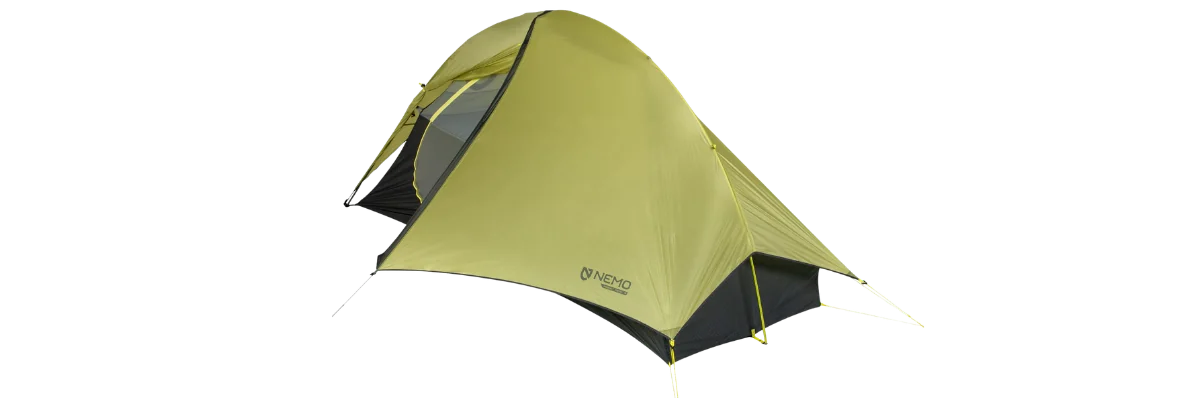
Specs at a Glance: Hornet Osmo 1P
| Spec | Nemo Hornet Osmo 1P |
|---|---|
| Price (USD) | $459.95 |
| Trail Weight (minimum) | 822 g / 1 lb 13 oz (29 oz) |
| Packed Weight | 1.02 kg / 2 lb 4 oz (36 oz) |
| Capacity | 1 person |
| Floor Dimensions | 87 x 39 in at head, tapering to 30 in at foot / 220 x 99 cm tapering to 75 cm |
| Peak Height | 39 in / 99 cm |
| Packed Size | 12.5 x 7.5 x 3.0 in / 32 x 19 x 7 cm |
| Shelter Type | Semi-freestanding, double-wall |
| Shelter Material | OSMO ripstop fly and floor; 15D nylon ripstop and no-see-um mesh canopy |
| Canopy Weight (oz/sqyd) | Not specified |
| Floor Weight (oz/sqyd) | Not specified |
| Number of Doors | 1 |
| Number of Vestibules | 1 (7.3 sq ft / 0.7 sq m) |
| Wall Construction | Double-wall (mesh inner tent plus separate rainfly) |
| Season Rating | 3-season |
| Trekking Poles Required | No (DAC Featherlite poleset included) |
| Warranty | Lifetime (Nemo Adventure Forever Guarantee) |
| Lead Time | Not specified (sold in stock through Nemo and retailers) |
Fly hydrostatic head is rated 1200mm and the floor 1500mm. The 1P poleset is a single hubbed DAC Featherlite structure weighing roughly 9.9 oz, and the tent ships with seven aluminum stakes, guy cord, a pole repair splint, and the Divvy Cube stuff sack.
Nemo Hornet Osmo 1P Tent Design and Build Quality
The headline material is OSMO, Nemo’s proprietary poly-nylon ripstop used in the fly and floor. It is spun from 100 percent recycled yarns, is PFAS-free, and Nemo claims roughly four times better water repellency and three times less stretch when wet than the sil-nylon used on older Hornets. In practice that anti-sag behavior is the real justification for the price. A fly that stays taut through an overnight soak is a fly you are not crawling out to re-tension at 2 a.m.
The pole architecture is a single hubbed DAC Featherlite set, premium aluminum that is both light and forgiving. What sets the Hornet apart is how short the segments break down, around 12 inches, which is why the packed length is so unusually small.
Nemo layers on volume-adding hardware rather than extra fabric. The Flybar volumizing pole clip spreads the fly at the head and adds headroom, triangulated guyouts and corner struts pull the walls outward and keep your sleeping bag off condensation, and Gatekeeper clips let you tie the door back one-handed. Inside there is an overhead Nightlight Pocket that diffuses a headlamp into a soft lantern.
The catch is that ultralight means delicate. The bathtub floor is a thin 1500mm fabric, and a recurring theme across owner reports is that it wants a footprint for anything rockier than a groomed pad. Seams are taped, zippers are lightweight but adequate, and the overall construction quality is what you expect from Nemo. This is careful
Setup and Pitch of the Hornet Osmo 1P
On paper you get about 20.6 sq ft of floor, an 87 inch length, a 39 inch width at the head that tapers to around 30 inches at the foot, and a 39 inch peak height. That peak is generous for the weight class and means sitting up straight is easy, one of the nicer surprises when you first crawl in.
The taper is the thing to watch. The head end is roomy enough to spread out a wide pad plus a few items, but the foot narrows noticeably. If you are six feet or taller, or a restless side sleeper, the combination of an 87 inch length and a pinched foot can feel snug, especially on a thick insulated pad that eats into headroom and length. One well-known tester (The Big Outside) measured the interior slightly larger than Nemo’s published number, closer to 22 sq ft, so real-world roominess may edge a touch above the spec.
Storage is where the 1P feels its price the least. You get a single side door and a single vestibule of about 7.3 sq ft, enough for a mid-size pack and shoes but not two people’s worth of gear. Inside there are only two pockets total: one large head pocket and the overhead Nightlight Pocket. Backpackers coming from the Big Agnes Tiger Wall often note they miss the extra pockets. The side-entry door is a genuine plus, easier to get in and out of than a head-entry tunnel, and it improves airflow.
Weather Performance of the Nemo Hornet Osmo 1P Tent
This is one of the easiest ultralight tents to pitch, and a good pick if you are still building confidence. The single hubbed pole goes up in one motion, and Nemo color-codes both the pole tips and the tent webbing, so you clip grey to grey and yellow to yellow without thinking. Most owners report a sub-five-minute pitch, often on the first try without instructions.
It is semi-freestanding, which is the honest caveat. The pole structure stands on its own, but the foot end must be staked out to reach full length and shape. Skip that and you lose usable floor. In practice you will want at least the four corners plus the vestibule staked, and all seven stakes if wind is in the forecast.
Because it is semi-freestanding rather than fully freestanding, it is a little fussier on hard or uneven ground where stakes do not bite well. On slabby alpine sites you may need rocks to anchor the foot. The upside of the tiny footprint is that it fits on small, awkward tent pads that a bigger tent could not.
The OSMO fabric matters here too. It does not stretch out and go slack after it gets wet, so the taut pitch you set at dusk is still taut in the morning. That no-sag behavior is one of the clearest day-to-day benefits of the material and removes a chore that plagues cheaper nylon tents.
Nemo Hornet Osmo 1P Tent Value and Comparisons
For a three-season tent this light, wind and rain performance is better than the spec sheet suggests. In extended field testing in Wyoming’s Wind River Range, the Hornet Osmo 1P rode out gusts around 40 mph and driving rain for hours and kept its occupant dry, though the tester did have to brace the windward wall by hand during the strongest gusts, which bowed the wall inward. Another reviewer testing at 11,000 feet in Colorado reported it stayed rigid in gusts estimated near 35 mph when pitched tight and fully guyed. The takeaway: get a taut pitch, use every guyout, and it handles real weather, but it is not a mountaineering tent and the walls will flex in a serious blow.
Rain shedding is a strong point despite a modest 1200mm fly rating. One owner reported 8.5 inches of rain in a single night with a completely dry interior. The OSMO fabric’s water repellency and stretch resistance do a lot of work here, keeping the fly tight so water runs off instead of pooling.
Condensation is well managed for a double-wall tent this size. The mostly-mesh canopy, the side door, and Nemo’s ventilation cutout in the fly promote cross-flow, and testers report only minimal dampness under the fly even on the cool, calm nights that usually cause the worst buildup. The volumizing corner struts also hold the inner walls off your bag, so incidental condensation is less likely to transfer. The bathtub floor rides reasonably high, which helps in pooling rain, though the thin floor material is still the weak link and a footprint adds peace of mind.
Hornet Osmo 1P Value and Comparisons
At $459.95 the Hornet Osmo 1P sits in the crowded, competitive heart of the semi-freestanding solo category. Here is how it stacks up against its closest rivals, framed by who each one actually suits.
MSR FreeLite 1. The FreeLite is the Hornet’s most direct competitor and comes in a few ounces lighter with a more rectangular, less tapered floor, which translates to more usable space at the foot. Both use a similarly modest 1200mm fly and both are semi-freestanding. Choose the FreeLite if you want the roomier rectangular floor and slightly lower weight; choose the Hornet if packability is king, because the Hornet’s 12 inch pole segments pack dramatically smaller than the FreeLite’s roughly 18 inch poles.
Big Agnes Tiger Wall UL1. The Tiger Wall is neck-and-neck on weight (within an ounce or two) and now uses Big Agnes’s Hyperbead fabric, which chases the same anti-sag, higher-waterproofness goals as OSMO. Its edge is interior organization and a slightly tauter side pitch: reviewers who have used both note the Tiger Wall holds its sidewalls a touch better and offers more interior pockets, while the Hornet tends to sag a little more at the sides. Choose the Tiger Wall if you want more pockets and a marginally more stable pitch; choose the Hornet for smaller pack size and the Flybar headroom.
Nemo Dragonfly Osmo 1P ($499.95). If the Hornet’s snug floor gives you pause, Nemo’s own Dragonfly is the comfort upgrade in the same fabric family: near-vertical walls, more livable volume, and a bigger vestibule for roughly six more ounces. Choose the Dragonfly if livability matters more than grams; choose the Hornet if you want the lighter, smaller-packing option.
There is also the Hornet Elite Osmo 1P ($599.95, about 1 lb 7 oz), the same basic design shaved down further for those willing to pay a large premium per ounce.
Who should buy the Hornet Osmo 1P? The thru-hiker or fastpacker who prioritizes low weight and the smallest possible pack profile, is comfortable staking out a semi-freestanding foot, and does not need palatial interior space. If you are tall, sleep on your side, or want a roomy basecamp tent, look at the Dragonfly or FreeLite instead.
Hornet Osmo 1P by Nemo Equipment FAQ
Is the Nemo Hornet Osmo 1P good in rain?
Yes, better than its 1200mm fly rating implies. The OSMO fabric sheds water well and stays taut when wet, and owners have reported staying dry through very heavy overnight rain. Pairing it with a footprint is smart insurance given the thin floor.
How does the Hornet Osmo 1P handle wind?
It holds up to roughly 35 to 40 mph gusts when pitched tight and fully guyed out, which is solid for a light three-season tent. In the strongest gusts the sidewalls can bow inward, so use all the guyouts and pick sheltered sites in exposed terrain.
Is the Hornet Osmo 1P hard to set up?
No. Color-coded poles and webbing plus a single hubbed pole make it one of the more beginner-friendly ultralight tents, with most people pitching it in under five minutes. Just remember it is semi-freestanding, so the foot end needs staking to reach full shape.
Do I need a footprint for the Nemo Hornet Osmo 1P?
It is not required, but strongly recommended. The 1500mm floor is thin and a recurring theme in owner reviews is added confidence and longevity from using the matched footprint, which costs roughly $79.95 to $99.95.
Will the Hornet Osmo 1P fit a tall person?
It is 87 inches long with a floor that tapers toward the foot, so sleepers around six feet and taller, or broad-shouldered side sleepers, may find it snug, especially on a thick pad. If interior room is a priority, the Nemo Dragonfly or MSR FreeLite offer more usable space.
Is the Hornet Osmo 1P a four-season tent?
No, it is a 3-season tent. The mostly-mesh canopy and light pole structure are made for spring through fall. For snow loading or serious winter wind you want a dedicated four-season shelter.
Does condensation build up in the Hornet Osmo 1P?
Less than you might expect for a double-wall tent this size. The mesh canopy, side door, and fly venting move air well, and testers report only minimal moisture even on calm, cool nights. The corner struts also help keep your bag off any dampness on the walls.