

Lunar Solo Quick Take
The Lunar Solo is the tent that keeps proving you don’t need to spend $500+ on Dyneema to get a genuinely comfortable ultralight shelter. It’s built for thru-hikers, budget-focused backpackers, and hikers who share a trail with a dog who need real interior volume without the weight of a traditional double-wall tent. Its standout strength is livability per ounce: 26 square feet of floor space and a roomy hexagonal footprint that fits taller sleepers with room to spare. Its main tradeoff is that you’re paying in setup patience and a few finish-line compromises, not in dollars: seam sealing isn’t included in the base price, and the single-wall silpoly build means you’ll manage condensation more actively than you would in a mesh-heavy double-wall design.
Pros
- Exceptional interior space and headroom for a 26 oz tent
- Long track record and thousands of miles of thru-hiker use
- Genuinely affordable compared to DCF competitors
- Easy, fast pitch once you’ve practiced it a few times
Cons
- Seam sealing costs extra (or requires DIY effort)
- Single-wall condensation needs active management
- Hexagonal footprint is awkward on small or oddly shaped campsites
- Angled walls limit headroom outside the center of the tent
Bottom line: At $260, the 26 oz / 740 g Lunar Solo is a 1-person, 3-season shelter that undercuts nearly every direct competitor on price while matching or beating most of them on interior space.


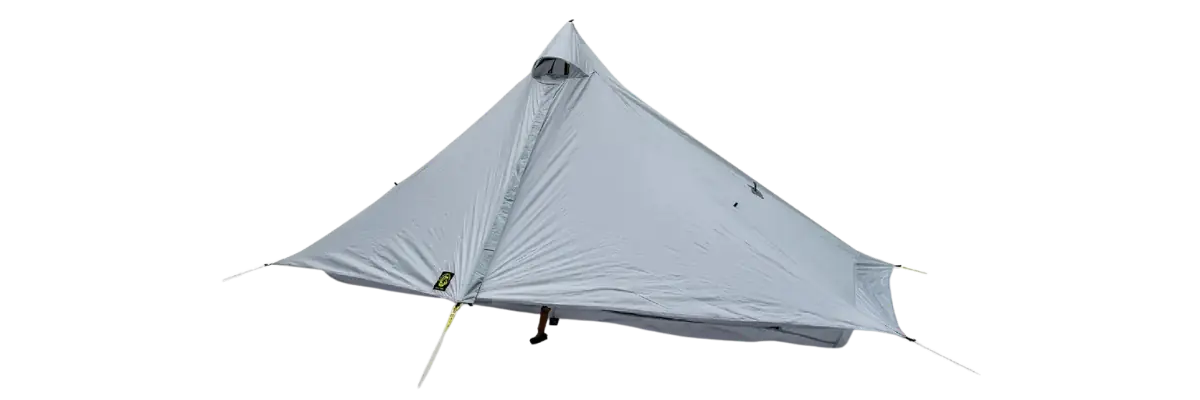
Specs at a Glance: Lunar Solo
| Spec | Detail |
|---|---|
| Price (USD) | $260 (seam sealing is an add-on: +$35 done by SMD, +$10 DIY kit, or free if you supply your own sealant) |
| Trail Weight | 26 oz / 740 g (excludes stakes and pole) |
| Packed Weight | Not specified by manufacturer (expect roughly 32–34 oz / 900–970 g with 6 stakes and a dedicated pole added) |
| Capacity | 1 person (1+) |
| Floor Dimensions | 90″ x 48″ (228 cm x 121 cm) |
| Peak Height | 49″ (124 cm) per current manufacturer spec |
| Packed Size | 11″ x 4.5″ |
| Shelter Type | Single-wall, non-freestanding, single trekking-pole hexagonal pyramid tent |
| Shelter Material | 100% silicone-coated polyester (silpoly); 20D canopy, 40D floor |
| Canopy Weight (oz/sqyd) | Not specified |
| Floor Weight (oz/sqyd) | Not specified |
| Number of Doors | 1 |
| Number of Vestibules | 1 (8.5 sq ft) |
| Wall Construction | Single-wall hexagonal canopy with 6-inch mesh perimeter above a 6-inch bathtub floor |
| Season Rating | 3-season |
| Trekking Poles Required | Yes, 1 pole adjustable to 49″ (dedicated 49″ pole sold separately) |
| Warranty | Lifetime warranty to the original owner against manufacturing defects (repair or replace at SMD’s discretion; normal wear and tear not covered) |
| Lead Time | Ships within 1 business day; add 1-2 business days if you choose the in-house seam sealing service |
SMD Lunar Solo Tent Design and Build Quality
The Lunar Solo’s build is straightforward, which is part of the appeal. The canopy uses 20-denier silicone-coated polyester, and the floor steps up to a burlier 40D silpoly, a sensible weight distribution since the floor takes the most abrasion. Six Moon Designs switched the whole shelter to silpoly a few years back, and it’s a meaningful upgrade over the silnylon predecessor: silpoly doesn’t stretch or sag nearly as much when it gets wet, which matters a lot on a single-pole pyramid design where a taut pitch is doing most of the structural work.
Seam construction is where the price becomes visible. The tent ships unsealed by default, and because the floor’s silicone coating won’t reliably hold standard seam tape, SMD either seals it in-house before shipping (for a fee) or sends you a DIY kit. This isn’t a flaw exactly, but it is a genuine added cost and step that pricier competitors often bake in.
Hardware is minimal but functional: a #3 YKK zipper on the door and vestibule, reinforced guyout points at the corners and peak, and re-tensioning straps on every tie-out so you can adjust tautness from inside your sleeping bag. The 6-inch bathtub floor guards against splashback, and the floating floor and floating canopy design reduce stress transfer, which is a smart touch for keeping a budget tent durable over years of use. Nothing here is exotic. It’s a tent that spends its material budget on the floor and fabric grade rather than fancy hardware, which is the right call for the price point.
Setup and Pitch of the Lunar Solo
This is where the Lunar Solo earns its reputation. 26 square feet of floor space and a 49-inch peak height put it well ahead of most solo trekking-pole tents, many of which sacrifice headroom to save weight. The floor measures 90″ x 48″ (228 cm x 121 cm), generous enough that hikers over 6 feet tall regularly report sleeping diagonally free or stretched fully without touching either end wall.
The catch is the hexagon shape itself: because the walls slope steeply from a single center pole, usable sitting headroom is concentrated near the middle of the tent. Move toward the edges and the angled walls close in fast, so side sleepers who like to sit up near the wall to change clothes will find themselves ducking. It’s not a dealbreaker, but it’s a real tradeoff between the tent’s roomy footprint and how much of that footprint you can actually sit up in.
The 8.5 square foot vestibule is large enough for a full pack, wet shoes, and cooking during a storm, accessed through a single side-entry door with a zippered closure. There’s a mesh cargo pocket inside for small items, but this is not a tent with multiple internal organization pockets. Two people can technically squeeze in in a pinch, but this is designed and sized as a true solo shelter, and most reviewers treat two-person use as an emergency measure rather than a real option.
Weather Performance of the SMD Lunar Solo Tent
Pitching the Lunar Solo is fast once it clicks, but there’s a real learning curve before that happens. It uses a single trekking pole (or dedicated 49″ pole) with 6 stakes at the base, and because it’s a non-freestanding pyramid design, getting a taut, symmetrical pitch depends entirely on stake placement and tension, not on pole geometry doing the work for you.
Most new owners report needing several practice pitches in the yard before they can set it up confidently in the field, and multiple reviewers specifically recommend this rehearsal before your first trip. Once you know the sequence, though, pitch time drops to under two minutes, which several long-term users have relied on during sudden weather. The silpoly fabric’s low-stretch behavior is a genuine advantage here: unlike silnylon, it won’t sag and go loose as it absorbs moisture overnight, so a well-pitched Lunar Solo tends to stay taut through a rainy night rather than needing a re-tension at 2 a.m.
Uneven or rocky ground is the tent’s weak spot. Because all 6 stakes need solid purchase to keep the hexagon’s tension balanced, sandy, rocky, or platform campsites make pitching noticeably harder, and the tent’s hexagonal footprint doesn’t fit neatly into small or irregularly shaped clearings the way a rectangular tent does. For beginners, this is a moderately beginner-unfriendly pitch on the first few tries, but not a difficult one once practiced.
SMD Lunar Solo Tent Value and Comparisons
Six Moon Designs built the Lunar Solo’s hexagonal shape specifically to shed wind and snow, and in practice it holds up well in that role. The steep, sloped walls spill wind from any direction rather than presenting a flat face to it, and multiple owners report solid performance in sustained winds in the 15-25 mph range with occasional stronger gusts, provided the pitch is taut and all stakes are well-set.
Rain shedding is a strength of the silpoly canopy, which carries a manufacturer-rated hydrostatic head of 3,000mm, comfortably above the threshold considered waterproof for a rainfly. The 6-inch bathtub floor keeps ground moisture and splashback out effectively. The one real caveat, repeated across several long-term reviews, is that the door must be oriented correctly relative to wind and rain direction during pitching; get this wrong and water can find its way past the vestibule opening.
Condensation is the honest weakness of any single-wall shelter, and the Lunar Solo is no exception. SMD addresses this with a 6-inch mesh band above the bathtub floor and a high vent at the peak to keep airflow moving, and this genuinely helps, but it doesn’t eliminate the issue in humid, still conditions or cold nights where temperature differential is high. Users who’ve run it through humid summers describe it as noticeably warmer and more prone to interior moisture than in cooler, drier shoulder-season use. If you’re headed somewhere consistently muggy, expect to manage condensation actively rather than assume the vents solve it for you.
Lunar Solo Value and Comparisons
At $260, the Lunar Solo occupies a specific niche: it’s roomier than lighter competitors and cheaper than comparably spacious ones. How it stacks up depends heavily on what you’re optimizing for.
Against the Durston X-Mid 1 (roughly $240-280, about 28 oz / 795 g trail weight), the comparison is close on price but different on design. The X-Mid is a double-wall tent with an offset pole geometry that creates two large vestibules and generally better livability at the edges of the tent, plus less condensation exposure since the inner mesh body sits apart from the fly. If you want double-wall convenience and don’t mind a slightly heavier pack, the X-Mid 1 is the stronger all-around choice. If you prioritize the Lunar Solo’s larger single-space footprint and proven long-term durability record, or you specifically want a design many thru-hikers have already tested over thousands of trail miles, the Lunar Solo holds its own.
Against Gossamer Gear’s The One ($255, 17.7 oz / 503 g), the Lunar Solo gives up over 8 ounces but gains a full trekking pole’s worth of setup simplicity: The One requires two trekking poles rather than one, which matters if you’re not already carrying a pair or you hike with a single pole. The One also ships with factory-taped seams already sealed, no add-on fee required, which meaningfully closes the effective price gap once you account for the Lunar Solo’s seam sealing cost. If ounces matter more to you than an included pole and pre-sealed seams, The One is worth serious consideration.
Against Zpacks’ Plex Solo ($599, 13.9-15.4 oz depending on fabric weight), there’s really no contest on weight, but the price difference is stark: you could buy two Lunar Solos and still have money left over. The Plex Solo’s Dyneema fabric doesn’t sag when wet and eliminates the seam-sealing question entirely (DCF seams are taped, not sewn), but that performance comes at more than double the cost.
Choose the Lunar Solo if you want maximum interior space and a single-pole setup at the lowest price in this class, and you’re comfortable managing single-wall condensation and a DIY-or-paid seam sealing step. Look elsewhere if you want a fully sealed tent out of the box, need two-door ventilation, or your budget stretches comfortably into DCF territory.
Lunar Solo by Six Moon Designs FAQ
Is the Six Moon Designs Lunar Solo actually waterproof? The canopy fabric is rated to 3,000mm hydrostatic head, which is solidly waterproof, but the tent does not come with seams sealed by default. You need to add SMD’s seam sealing service, do it yourself with the included kit, or use your own sealant before it’s fully waterproof in sustained rain.
How hard is the Lunar Solo to set up? It has a real learning curve for the first few pitches since it’s a non-freestanding, single-pole design that depends on stake tension for its shape, but most users report a sub-two-minute pitch once they’ve practiced it a handful of times in their yard first.
What season is the Lunar Solo rated for? It’s a 3-season shelter. The steep hexagonal walls shed snow reasonably well in shoulder-season conditions, but it’s not built or marketed as a true winter or 4-season tent.
How much does the Lunar Solo actually weigh with stakes and a pole? The published 26 oz / 740 g trail weight excludes stakes and the trekking pole. Once you add 6 stakes and a dedicated pole (if you’re not already carrying trekking poles), expect the all-in weight to land somewhere around 2 pounds, though Six Moon Designs doesn’t publish an official all-in figure.
Does the Lunar Solo get condensation? Yes, as with any single-wall tent, especially in humid or still conditions. SMD’s mesh venting band and peak vent help manage it, but you’ll still want to crack the vestibule for airflow on warm, muggy nights.
Will a tall person fit comfortably in the Lunar Solo? Yes, its 90-inch floor length is generous, and multiple owners over 6 feet tall report sleeping without touching either wall. Just note that sitting headroom narrows quickly as you move away from the center peak.
Do I need a footprint or ground sheet with the Lunar Solo? It’s not strictly required since the floor has a bathtub design, but a lightweight ground sheet is commonly recommended to protect the floor fabric from abrasion and extend its lifespan, especially on rougher or rockier campsites.